By Nnaoke Ufere, PhD*
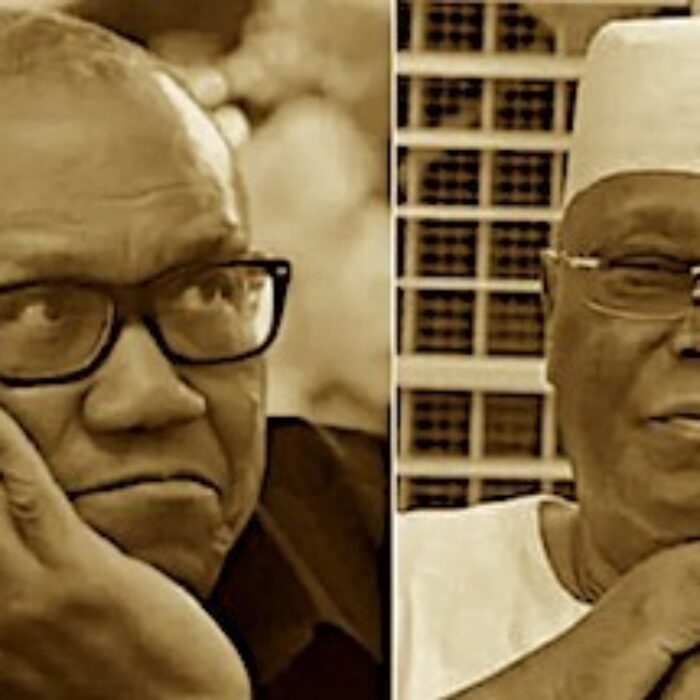
Mr. Peter Obi’s presidential ambition, born in February 2019 when he joined Atiku Abubakar as running mate with eyes firmly set on the presidency, may have reached its inglorious and self-inflicted demise in July 2025.
It died from a reckless act of politicide—political suicide in its rawest form. The cause of death: a fatal lapse in judgment, an opportunistic betrayal, insatiable ambition, and shameless political expediency.
The final nail was struck on July 3, 2025, when Obi officially abandoned the Labour Party, the Obidient movement, and the six million Nigerians who voted for him believing he was different. In that moment, he didn’t just leave a party, he walked away from the very platform that gave him national relevance and defected, without thought or principle, to the ADC, a political graveyard teeming with zombie politicians majority of Nigerians have long rejected.
Like Tinubu, self-serving figures such as Atiku, El-Rufai, and Amaechi are shameless relics who have lost both public credibility and any sense of purpose, yet they continue to cling to relevance in Nigeria’s political arena. Spent and out of ideas, they are united not by any vision for Nigeria or values that can mend a broken nation, but by sheer opportunism and desperation. As my village elders say: show me your company, and I’ll show you your character. No eagle flies with vultures, and if you eat dead carcass with vultures, you become one of them.
It is within this rotten political company that Peter Obi has now chosen to make his home. What died in July 2025 was not just a political career or presidential ambition, but the carefully curated illusion that Obi was different, a man of impeccable character. In the end, he proved to be no less a creature of the swamp than the others.
His much-touted “Catholic Boy” image has since been exposed as a fraud. Beneath the clean and humble exterior lies a ruthless political operator—just as desperate, conniving, calculating, and self-serving as the very politicians he once condemned.
Never in recent Nigerian political history has a figure so revered undone his own legacy in a single, monumental miscalculation. By choosing expediency over principle and values, Obi effectively ended his political life and erased the record of goodwill he once enjoyed. Seventy percent of self-identified Obidients interviewed after Obi’s defection said they would never support or vote for him again. Many expressed deep shock and disappointment.
Adding Insult to Injury
Obi compounded the folly of his defection by claiming that his “primary concern is the well-being of Nigeria and its people,” a statement that insults the intelligence of every Nigerian. His true motive is obviously self-centered: he seeks to keep himself relevant and his political career alive.
To further rationalize the mindless move, Obi now says he joined the new coalition only to defeat the APC and make Nigeria work. Yet who is he trying to deceive? He has always known how destructive the APC could be. As Atiku’s running mate in 2019 he said so himself. If he truly believed the party was harmful, why did he abandon the PDP in 2023, strip Atiku of crucial votes, and hand the 2023 presidency to the very party he claims is ruining the nation?
The answer is simple: time and again, Obi has shown that he acts only in his own interest. The broken nation, our collapsing economy, and our long-suffering citizens are secondary concerns, useful only insofar as they serve his political ambitions. This self-centered approach is what ultimately handed the presidency to Tinubu.
Had Obi not fractured the opposition in 2023 through impatience, a thirst for instant gratification, and blind ambition, Atiku, corrupt and compromised as he is alleged to be, would likely be in power today. Whether Atiku would have governed any better remains uncertain, but what is clear is that Obi’s gamble deepened Nigeria’s suffering and delivered the country to a regime of ruin.
This is no accident. Obi embodies the typical Nigerian swamp politician—one who masks ambition with populist slogans and treats people, parties, and movements as disposable tools. His rise to national prominence was built on the energy of the Obidients and the platform of the Labour Party, but once that vehicle failed to deliver the presidency, he discarded it without hesitation.
Rather than stay to unite and rebuild the Labour Party into a true national force, he chose to run for the exit. It was a calculated betrayal disguised as pragmatism, revealing the same cynical playbook he once claimed to oppose.
Throughout his political career Obi has shifted platforms for tactical gain rather than principle and strategy. He cultivates an outsider’s image while practicing the same cut-throat, mercantile politics. Obidients and the general public appear to him not as stakeholders with rights and dignity, but as bargaining chips that can be bought, bartered, and written off.
Building on this deceitful pattern, Obi insinuated to Nigerians in the run-up to 2023 that Atiku was irredeemably corrupt and unfit to lead. He implied to his supporters that, as a man of principle, his break with Atiku was final and irreconcilable. Obi insisted Atiku was untrustworthy and portrayed him as a deceitful opportunist who used and discarded him in 2019. He framed their split as a moral stand, a necessary departure from the old guard of corrupt, transactional politics.
Yet today, Obi shamelessly seeks Atiku’s approval, shares platforms with him, and negotiates behind closed doors with the very man he once called untrustworthy, corrupt, and a symbol of everything wrong with Nigerian politics. Yes, politics makes strange bedfellows, but this is not strategy, it is surrender. It is not pragmatism, it is hypocrisy of the highest order.
By crawling back to Atiku, Obi has not just betrayed his own words; he has betrayed the millions who believed he stood for something different. This is not a tactical alliance, it is the full collapse of whatever moral high ground he once claimed to hold.
Furthermore, Obi, through his surrogates, denounced El-Rufai as a dangerous religious bigot and an unrepentant ethnic chauvinist. In return, El-Rufai mocked Obi as an empty vessel full of empty rhetoric, a small-state governor, a Nollywood actor, a petty trader posing as a statesman, and boldly declared he would never become president. Yet today, Obi, on all fours, shamelessly courts his approval, stands beside him on the ADC stage, and cuts backroom deals with the same man he once condemned as a threat to Nigeria’s unity, peace, and future. This is more than a political reversal; it is a total moral collapse.
By crawling back to the very forces he vowed to resist, Obi has disgraced both his message and his movement. And let it be clear: this will not end well for him politically. Because once trust is broken and credibility destroyed, no alliance, no matter how expedient, can restore what has been lost. In the end, it is people who vote, not coalitions.
As one would expect, some self-serving Igbo leaders are quick to dismiss genuine concern about Obi abandoning LP for ADC with the cynical phrase, “Politics isn’t monogamy, every Nigerian politician divorces and remarries in another party.” But this glib excuse masks a deeper rot: the normalization of betrayal, the erosion of principle, and the commodification of public trust. Shame on these so-called Igbo leaders.
Ultimately, character remains the defining quality of any credible presidential candidate. Obi’s conduct raises serious doubts about his fitness for public office, echoing Heraclitus’s warning that a person’s character shapes his destiny. By revealing a deficit of moral character, Obi has undercut every other attribute that might have distinguished him as a leader.
Betrayal of the Obidients
Having crossed that line to the other side, Obi has, in effect, sold his soul. He should no longer be trusted, believed, or heeded politically. To millions who rallied behind him in 2023, he offered only abandonment, throwing the Obidients beneath the ADC train so his own ambitions might roll forward. In their eyes he has become the greatest liar of all time.
The Obidient movement, born in hope, now risks becoming just another chapter in Nigeria’s long history of political betrayal unless its members choose to take a different path.
Consequently, the question now confronting Obidients is direct and unavoidable: will you continue to follow a man who has betrayed your trust, bartered his integrity, and demonstrated both poor judgment and dishonesty?
Obi’s Deadly Options and the Poisoned Chalice
According to insiders who spoke on condition of anonymity and are familiar with the negotiations, the ADC coalition partners seem to have dangled two options before Obi to lure him in: a presidential nomination or the position of running mate to their preferred candidate. Each option is a chalice laced with hemlock, dressed up as opportunity but deadly to his political life.
If the coalition selects Obi as its presidential candidate on the condition that he serve only one term to complete the South’s eight-year rotation, assuming Tinubu is defeated, he will be inheriting a poisoned chalice. Even if he wins, which remains a major uncertainty, it becomes a Pyrrhic victory. The one-term pledge weakens him from the start, stripping him of the political leverage every first-term president needs to push through reforms, while competing power centers within the alliance immediately begin scheming for the 2031 succession.
This flawed arrangement becomes even more troubling when placed against the backdrop of Nigeria’s deepening crisis. The country is in the grip of a national emergency—soaring inflation, a collapsing naira, mass unemployment, worsening insecurity, and a political order suffocated by corruption and ethnic patronage.
These are not short-term setbacks but entrenched, structural crises that demand bold, principled, and visionary leadership. They cannot be addressed by a placeholder or a figurehead merely passing through power. Yet that is precisely what the coalition appears to be offering Obi: a four-year, lame-duck presidency with no mandate to confront Nigeria’s urgent challenges and no intention of seeking re-election.
Such a scenario reveals more than poor political strategy, it reveals a desperate, transactional gambit. It exposes a man whose ambition outweighs any serious commitment to reform. In a moment that demands courage and clarity, what is being presented instead is compromise and calculation.
Nigeria cannot afford a ceremonial president with an expiration date. The scale and complexity of the country’s problems require long-term planning, consistent execution, and the political will to confront powerful interests. A one-term president, beholden to the coalition that installed him and unable to seek a fresh mandate from the people, will be weak, compromised, and ultimately ineffective. That is not leadership. That is capitulation.
Worse still, with Atiku, El-Rufai, and other seasoned operators jockeying behind the curtain, Obi would spend much of his truncated mandate managing factional demands and defending his own agenda against the very patrons who installed him.
Far from guaranteeing a lasting legacy or even a stable four years, this arrangement positions Obi as a disposable bridge between entrenched interests and their chosen successor, not as a transformative leader in his own right.
The vice-presidential option is even weaker. Accepting the deputy slot under Atiku, coupled with a handshake pledge that Atiku will step aside after four years, leaves Obi at the mercy of political promises that Nigerian history shows are rarely honored once power is secured.
As vice president he would have limited authority, little control over patronage networks, and no certainty that the principal will surrender the reins in 2031. Should Atiku decide to seek a second term, Obi’s path to the top job could vanish overnight.
Atiku will likely use Obi for his own revenge. Obi single-handedly deprived Atiku of his life ambition, and now it’s time for Atiku to humiliate Obi. This is the nature of transactional politics: what goes around comes around. Meanwhile, the nation declines, the people suffer, and democracy, whatever is left of it, decays.
In short, both scenarios reduce Obi to a bargaining chip in a coalition built to protect the ambitions of others, not a clear route to the presidency he seeks.
But a desperate man, like Obi, will do desperate things. Consumed by the hollow ambition to become the first Igbo president since the dawn of the Fourth Republic, he is willing to trade principle for proximity to power. He will shake hands with those he once condemned, kneel before men he once accused of ruining the country, and justify any opportunity to become president.
This obsession with being “the first” has blinded him to the cost of the path he is taking. He forgets that it is not the title that redeems a people, but the leadership that accompanies it. If a presidency is built on compromise with the same forces that have long impoverished and oppressed the Nigerian people, then what is its true worth? A symbolic victory means little if it comes at the cost of real change for the millions who continue to suffer.
Who Nigeria Needs
Nigeria is in crisis. This moment demands more than a weak leader, clever slogans or tactical alliances; it demands a leader with iron will, clear principles, and the courage to make painful, decisive choices.
Peter Obi has proven he is not the leader Nigeria needs in this moment of national crisis. Time and again he has shown himself to be transactional and calculating, quick to abandon allies and causes when they no longer serve his ambition.
When pressure mounts, he abandons his principles and values, choosing to retreat rather than stand his ground. A nation on the brink cannot entrust its fate to a man whose instinct is to hedge rather than to lead, whose record shows neither the stamina nor the policy depth required for genuine reform.
We have already suffered under one self-centered, unprincipled politician—Bola Tinubu—who placed personal ambition above national interest. Nigeria cannot survive another. Obi mirrors the same traits: blind ambition, a willingness to bargain with anyone who advances his quest, and no record of the bold, coherent solutions our emergency demands.
Nigeria needs a leader with the courage to resist coalition godfathers, confront entrenched interests, and steer the nation through its storm, not another weak-willed opportunist. What this country deserves is a visionary, a problem solver, a unifier, and a capable leader ready to fight for the welfare of all Nigerians.
For the sake of over 200 million citizens, Peter Obi, Atiku, El-Rufai, or any member of the desperado coalition cannot be the answer, not even for a single day.
*About the author
Nnaoke Ufere is a leading voice in African public thought and policy. He writes a weekly opinion column for the African Mind Journal, where his work shapes national conversations on leadership, governance, and reform. A Harvard alumnus and PhD holder in Strategic Management from Case Western Reserve University, Ufere is an influential author, public intellectual, and global development analyst whose insights on U.S.-Africa relations and institutional accountability continue to challenge the status quo and inspire change.