By Dr. Nnaoke Ufere*
I make this public appeal to Nigerian voters from the standpoint of someone who has personally entered the arena and sought the responsibility of leading this country. I contested for the presidential nomination of the Peoples Redemption Party. I therefore understand that asking Nigerians to entrust you with the presidency is not merely a request for their votes. It is a request for their confidence, their future, and the immense power to make decisions that will shape the lives and impact the livelihoods of more than 230 million of our people.
Anyone who seeks that responsibility owes Nigerians far more than a catalogue of President Bola Tinubu’s failures. Opposition is not a governance programme, and anger at an incumbent is not a substitute for a national transformation plan to solve the complex problems facing our country.
A serious presidential contender must therefore tell Nigerians, clearly and specifically, what he believes, what he will change, what he will preserve, what he will end, how he will govern differently, and how he will pay for what he proposes. Above all, he must state the measurable results by which Nigerians should judge his presidency.
Our long-suffering citizens, already carrying the weight of economic hardship, insecurity, unemployment, failing public services, and declining confidence in government, cannot afford another election built around personalities, slogans, grievances, and promises without a credible plan for governing.
That is why the direction of the opposition campaign for 2027 concerns me, and it should concern every Nigerian who wants a change in leadership that will reverse the nation’s decline and deliver tangible results.
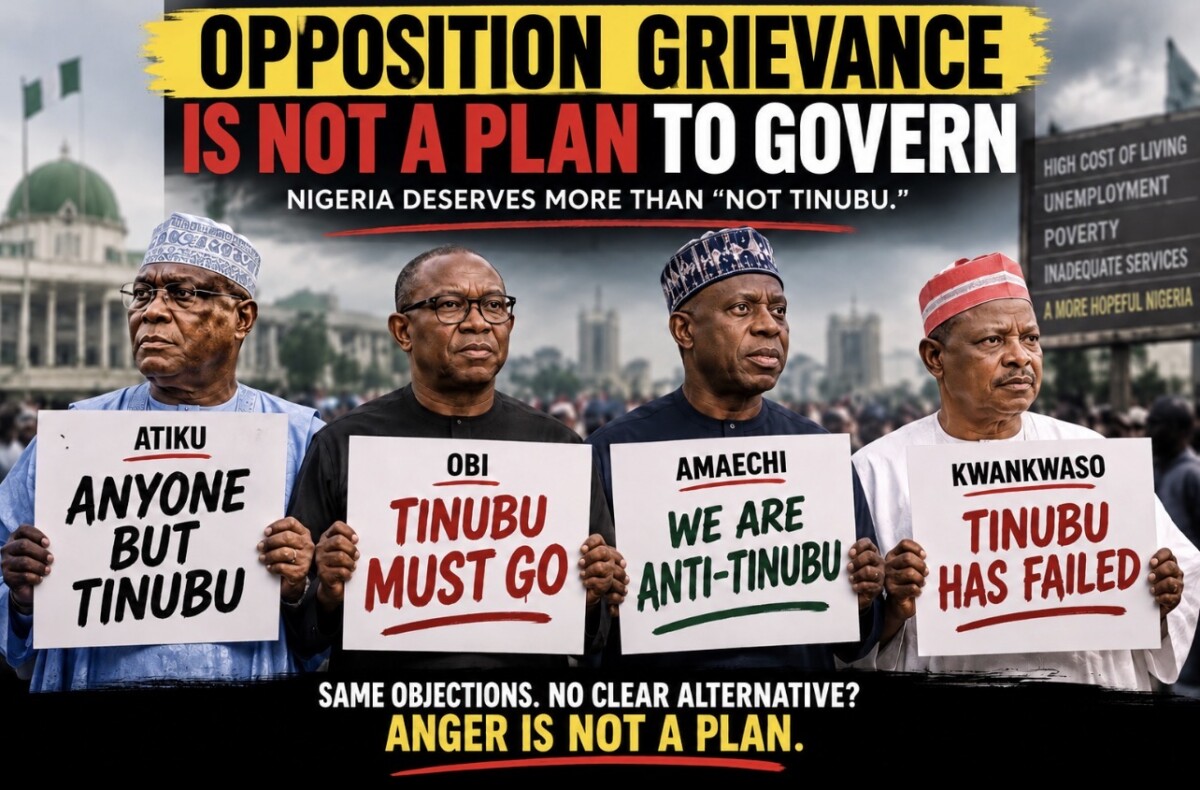
Listen to Atiku Abubakar and Rotimi Amaechi, Peter Obi and Rabiu Kwankwaso, the other lesser candidates, and their surrogates, such as David Mark, Buba Galadima, and Hakeem Baba-Ahmed, and the message is remarkably consistent: Tinubu has failed, Nigerians are suffering, the APC must go, and the opposition must unite to remove it from power. Strip away the different speeches and interviews, and their core campaign agenda is essentially the same: Anyone but Tinubu.
The problem, however, is that “Anyone but Tinubu” tells us only who should not be president. It does not tell us how Nigeria should be governed, what would change under a new government, or whether those seeking power have the competence, integrity and courage to solve our country’s problems and deliver better results to long-suffering Nigerians.
The opposition is making a serious mistake that could cost it the 2027 presidential election by framing the contest as Tinubu versus anti-Tinubu. Nigerians may be angry, and with good reason, but anger is not a programme for government. Grievance is not policy. And opposition to Tinubu, however strongly felt, does not answer the questions that should define the election: What is your plan for Nigeria that is different from what Tinubu has already done or proposes to do? How will you deliver it? And why should Nigerians trust you to govern?
This matters because Nigeria has been here before. Yes, Nigerians are angry, and we have had reason to be angry for much of the Fourth Republic. We were angry with Obasanjo and turned to Yar’Adua. We became dissatisfied with Jonathan and voted for Buhari. We became frustrated with Buhari and, in 2023, millions voted for Tinubu while millions more backed opposition candidates promising a break with the past. Now, once again, anger with the incumbent is being mobilised as the central argument for changing the government.
But after more than a quarter-century of voting our anger, the problems that make us angry remain. Election after election, politicians have learned to convert public frustration into political opportunity. We become consumed with removing whoever is in power and pay too little attention to the people asking to replace them.
That must change. Every candidate asking Nigerians for the presidency should have to answer basic questions: Do you have the programmes, competence, ideas, discipline and character to solve the problems causing our anger, or are you simply using that anger as your route to power?
That is the trap Nigerian voters must refuse to repeat in 2027. Anger can remove a government. It cannot tell us whether those replacing it know how to govern. Replacing Tinubu is not, by itself, a plan for Nigeria. The real questions are what comes after Tinubu, who can deliver it, and what measurable difference it will make in the lives of ordinary Nigerians.
If the opposition believes Tinubu chose the wrong reforms, it should identify the right ones and present them to the country. If it believes the reforms were necessary but badly implemented, it should explain what it would do differently. If it believes ordinary Nigerians were forced to bear too much of the adjustment while government protected itself, it should tell us exactly what privileges, expenditures and institutions it would cut.
Only then would Nigerians have a real presidential contest: not simply Tinubu against anti-Tinubu, but competing programmes for governing the country. The government would have to defend its record, its policies and the results it claims they will produce. The opposition would have to present an alternative with clear policies, costs, priorities and measurable outcomes.
After reviewing their position documents, public statements and interviews, I put these questions directly to Atiku and Amaechi, Obi and Kwankwaso, the other candidates, and those making the case for them, including David Mark, Buba Galadima and Hakeem Baba-Ahmed: Where is your alternative programme for governing Nigeria?
You condemn Tinubu for removing the petrol subsidy. Would you restore it? If so, at what cost, how would you pay for it and what would you cut to fund it? If not, what exactly would you do differently? What are your policies on the naira, taxation, government borrowing, debt, crude production, refining and the cost of government?
What will you do about food? Millions of Nigerians are struggling to afford basic meals while farmers contend with insecurity, high input costs, poor roads, inadequate storage, limited access to credit and enormous post-harvest losses. How will you increase food production, get farmers safely back to their farms, reduce production and transportation costs, improve storage and distribution, and bring food prices within the reach of ordinary Nigerians? What, specifically, is your plan to feed the country and avert the hunger and starvation confronting too many Nigerian families?
Then there is electricity. No modern economy can function without steady and affordable power, yet Nigerians have lived for decades with unreliable supply while households and businesses spend heavily generating their own electricity. Atiku, Amaechi, Obi and Kwankwaso, what will you do differently? How will you increase generation, fix transmission bottlenecks, improve distribution and attract the investment required to provide reliable power?
What is your position on electricity pricing and subsidies? How will you protect poor households without making the sector financially unviable? How will you reduce dependence on generators and bring down the energy costs built into the price of almost everything Nigerians buy? Most importantly, what measurable electricity supply will you commit to delivering within four years? If you cannot explain how Nigeria will get steady and affordable electricity, you have not presented a credible plan for a modern economy.
What is your economic programme? How will you move Nigeria from an economy that imports too much and produces too little to one that produces, processes and exports more? How will you raise productivity, attract investment, expand manufacturing and exports, and create an environment in which entrepreneurs and innovators can build businesses without being crippled by unreliable infrastructure, multiple taxation, expensive credit and regulatory obstruction?
Where, specifically, will the jobs come from? Nigeria does not need another manifesto promising millions of jobs by presidential declaration, or another collection of training programmes, empowerment schemes and government initiatives with impressive names. Which industries can realistically absorb millions of unemployed and underemployed Nigerians, particularly young people? What will make Nigerian manufacturing competitive? How will you expand labour-intensive exports? What will you change in agriculture and agro-processing? What policies will make it rational for a company to hire its next hundred employees in Aba, Kano, Kaduna or Ibadan rather than remain small, automate or invest elsewhere?
How will you bring inflation and the cost of living under control without suppressing the production, investment and employment the economy needs? It is easy to condemn high prices. What will you actually do to bring them down? Will you support monetary discipline when high interest rates become politically painful? Will you reduce deficit financing? How will you coordinate fiscal and monetary policy? What will you do about the structural causes of food inflation, including insecurity, transport costs, poor storage, low agricultural productivity and restrictions on trade?
What is your policy on the naira? Will you return to a heavily managed exchange rate, maintain the present framework or introduce another system? Will politically connected and favoured companies again receive preferential access to foreign exchange? If you promise Nigerians a stronger naira, what economic mechanism will produce it and sustain it?
And what will you do about government borrowing and Nigeria’s debt burden? How much more debt are you prepared to take on, and for what purposes? What limits will you place on borrowing? How will you ensure that new debt finances productive investment rather than recurrent expenditure and political projects? How will you prevent debt service from consuming resources that should be going to infrastructure, education, healthcare and economic development?
These questions require more than promises of jobs, lower prices, a stronger naira and faster growth. Nigerians should be told what policies will produce those results, what they will cost, what trade-offs will be required and how success will be measured.
What about the size and structure of government? Will you reduce the number of federal ministries, departments and agencies, eliminate duplication and cut the political and administrative cost of government? Which institutions will you abolish, merge or restructure? What functions should Abuja stop performing?
And where do you stand on restructuring Nigeria? Will you transfer substantial powers, responsibilities and resources from the federal government to the states and local governments? Will you give states greater authority over policing, infrastructure, taxation, economic development and their resources? Will you support genuine financial and administrative autonomy for local governments? Nigerians deserve to know what you believe the federal government should control, what should belong to the states and local governments, and how you intend to make that division of powers work.
Education demands equally specific answers. What will you do about millions of children who are out of school, failing public schools, poorly equipped classrooms, weak teacher training, repeated disruption of tertiary education and graduates leaving school without the skills employers need? How will you improve literacy and numeracy, expand technical and vocational education, strengthen universities and connect education more directly to employment, enterprise, science and technology? What measurable improvements will you commit to delivering within four years?
The same test applies to security. Beyond replacing the people currently in charge, what will you actually change? Will you support and implement state police structure and operational autonomy? Will you change the command structure? How will you improve intelligence gathering and coordination? What will you do differently against terrorism, banditry, kidnapping and organised crime? Will you investigate and prosecute known or credibly identified sponsors, financiers and enablers of terrorism, including those within government, the military, political networks and religious organisations, regardless of their position or influence? How will you make it possible for farmers to return safely to their land, businesses to operate without paying criminals for protection and Nigerians to travel across their own country without fear?
Then there is corruption. Atiku, Amaechi, Obi and Kwankwaso, what, precisely, will you do that previous governments have failed to do? What penalties will you impose for embezzlement, looting, theft of public funds and assets, contract fraud and collecting public money for projects that are abandoned or never executed? Will you support the death penalty for those convicted of the most serious forms of public corruption and theft, regardless of their wealth, political connections or status?
And are you prepared to subject yourselves to the standards of transparency and accountability you promise to impose on others?
Will you, Atiku and Amaechi, Obi and Kwankwaso, make full public declarations of your beneficial ownership interests, financial assets and physical assets in Nigeria and abroad, and permit those declarations to be independently verified by a reputable international forensic audit firm? Will you disclose assets held directly and through companies, trusts, nominees and other entities in which you have a beneficial interest?
If you want Nigerians to believe that you will confront corruption differently, demonstrate it before asking them to entrust you with the presidency.
And to David Mark, Buba Galadima, Hakeem Baba-Ahmed and others publicly advocating for these candidates: these are the questions you should be helping them answer. Telling Nigerians repeatedly that Tinubu has failed is not enough. Nigerians already know what they think of Tinubu. What they need from you is a clear explanation of why the people you want to replace him with will govern differently and produce better results.
Atiku, Obi and the others asking Nigerians to replace Tinubu must now prove that they seek power not merely because they believe he has failed, but because they have a credible programme for government, the competence and courage to carry it out, and convincing answers to the questions I have put to them. The test is not whether they can catalogue Tinubu’s failures. It is whether they can show Nigerians, in concrete terms, what they would do differently and why they can govern better.
Nigerian voters must demand those answers before giving anyone their votes. Hardship, anger and disappointment must not lower the standard by which we choose a president. We should interrogate every candidate, examine the numbers behind every promise, demand clear choices and measurable commitments, and refuse to accept slogans where there should be policy. Anyone asking for the power to govern Nigeria carries the burden of proving that he is ready for it.
Until Atiku, Obi and the rest of the opposition meet that test, “anyone but Tinubu” remains exactly what it sounds like: a coalition united by the determination to remove one man but without an adequate answer to the question that matters even more than removing him: What will you do with Nigeria if we give you the power to govern it?
They have only weeks to begin providing those answers. Nigerians should insist on them. No candidate should receive a vote simply because he is not Tinubu.
If the opposition continues to offer Tinubu versus anti-Tinubu, it is setting itself up to lose. And the consequence will not be theirs alone. Tinubu could win another four years, with Nigerians left to bear the consequences if he does not change course.
That is what is at stake in 2027.
*About the Author
Nnaoke Ufere is a leading voice in African public thought and policy. He writes a weekly opinion column for the African Mind Journal, where his work shapes national conversations on leadership, governance, and reform. He is the author of Covenant With Nigerians: Reversing Our Country’s Decline. He sought the Peoples Redemption Party’s presidential nomination for the 2027 election. Nnaoke graduated from the University of Nigeria, Nsukka with a first class honors degree in Electrical/Electronic Engineering in 1981. A Harvard MBA alumnus and PhD holder in Strategic Management from Case Western Reserve University, Ufere is a venture capitalist, influential author, public intellectual, and global development analyst whose insights on U.S.-Africa relations and institutional accountability continue to challenge the status quo and inspire change.