By Nnaoke Ufere, PhD*
Let me say plainly what many people are dancing around: the August 31 opposition summit will not produce a single candidate for the 2027 election, and most of its organisers know it. It is a boondoggle that will consume time, money and public attention while creating the appearance of progress without resolving the toxic rival ambitions tearing the opposition apart.
Look at where we actually are. Atiku is the ADC candidate, with Amaechi as his running mate. Obi has launched his campaign under the NDC, with Kwankwaso beside him. The lesser parties are guarding their tickets and whatever leverage they still possess. Campaign season has begun. Yet a group is asking these men to surrender tickets they have already fought to secure. That is not coalition building. It is daydreaming.
But let me ask the obvious question: who exactly is doing the asking? The so-called G-100. A pressure group. It runs no party, controls no campaign and has no authority to select or remove a candidate. It cannot force anyone to withdraw. It has presented no agreed rules, no voting process, no timetable and no guarantee that the losers will accept the outcome. So how is a group with no power to enforce its own decisions supposed to settle the hardest question in opposition politics?
Even the way the date slipped tells the story. First it was August 18, then it became August 31, because the organisers still needed to consult and did not want to collide with the peace accord signing. Think about that. You do not announce the summit and then go looking for agreement on what it is for. You get the agreement first. The order they have chosen gives the whole thing away.
There is also a lazy assumption underneath all of it, that you can take Atiku’s votes, add Obi’s, add Kwankwaso’s, pour them into one candidate and walk away with a winner. Voters are not property. They do not transfer like cash. Region, party loyalty, who the person actually is, whether people even bother to show up on voting day, all of that decides whether a vote moves or evaporates. Force an alliance and you can lose people even while you are collecting endorsements on stage.
But here is what really makes me doubt this, and it is their personal history, not theory. Atiku and Obi have done this before. In 2019 they were on the same PDP ticket, Atiku on top, Obi as his running mate, and they lost to Buhari. Then it fell apart.
By 2023 they were running against each other, Atiku on the PDP, Obi on Labour, and both of them lost to Tinubu. Except add their two totals together and you get more than Tinubu got. The partnership they threw away was, on the numbers, a winning one. That near miss did not bring them closer. It poisoned everything.
To Atiku’s people, Obi is the spoiler who walked out and split the vote and handed Tinubu the keys, and Atiku has said as much out loud. To Obi’s people, Atiku is the man who always has to be the candidate, who will never step back for anyone. And there are northern elites who, to this day, quietly blame Obi for making Tinubu president. You are asking two men who carry all of that, who could not even survive being on the same ticket, to now merge the rival parties they each command. Good luck.
That is the real problem, and it is bigger than bad planning. The summit is asking these two men to do something that makes no sense for either of them, and no amount of talking fixes that.
There’s a famous idea in game theory called the prisoner’s dilemma, where two people, each acting in their own rational self-interest, end up worse off than if they had simply trusted each other and cooperated. That is exactly the bind Atiku and Obi are in. Think of it as two prisoners in separate cells, each offered the same bargain: step aside for the other, or run. If they both step aside and back one candidate, the opposition has its best shot at removing Tinubu. Everyone can see that. It is the whole point of the exercise.
And still neither will do it, because only one of them can be president, so “step aside” does not mean compromise, it means surrender. Atiku is 78 and treats this as his last shot, so there is no next time to wait for. Obi has pledged to serve only one term to respect the North-South rotation, and if he gives that up he loses the very thing that makes him electable.
And honestly, that one-term promise reeks of desperation anyway. What is a first-time president going to accomplish in four years, with no second term to build toward and no control of either chamber of the National Assembly? He would spend half his time just begging lawmakers for the power to govern. It is a pledge that quietly admits how little he could really get done, offered not from confidence but because the rotation forced his hand: the only way a southerner can credibly ask the North for support in 2027 is to promise to hand power back in 2031.
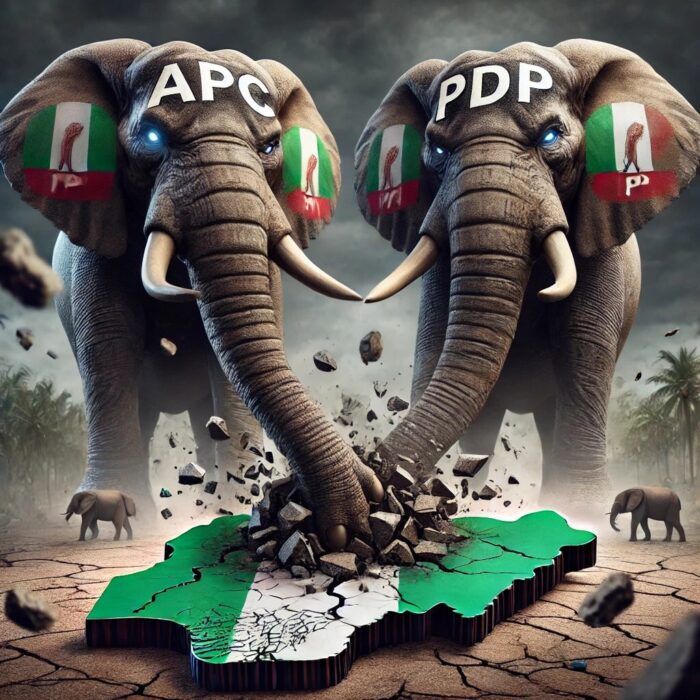
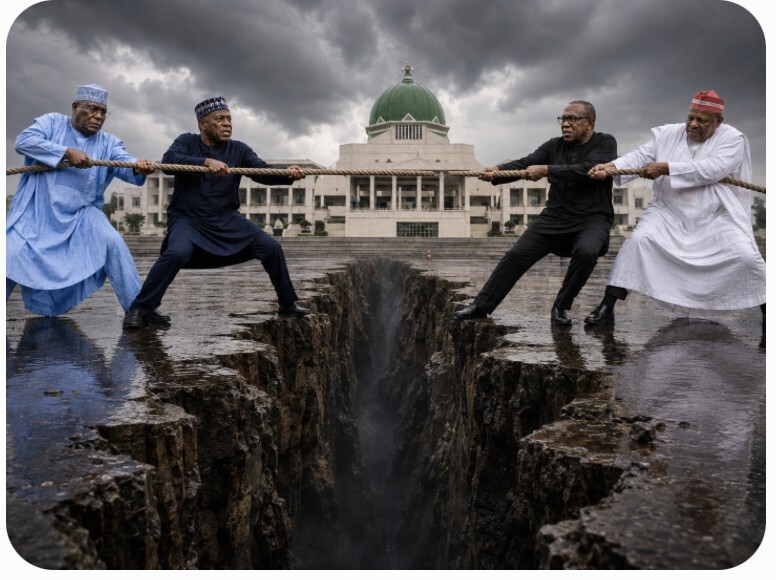
That is the central problem: neither man can support the other without helping him become president. Neither is willing to step aside, so both will run. The opposition vote will split three ways, and the president they both say they want to remove will remain in office.
This is the cruelest part. In the conventional prisoner’s dilemma, cooperation gives both sides a better outcome. Here, cooperation can benefit only one of them. Only one can become president, and neither is willing to sacrifice his final chance for the other. By refusing to agree on who should step aside, they ensure that neither succeeds.
Each man is acting in his own rational self-interest, protecting what may be his last opportunity to gain power. Yet those individual decisions produce the very outcome they both claim to oppose: the incumbent remains in office. No summit can change that calculation. A photograph of them smiling together on a stage cannot erase the central fact that, for at least one of them, opposition unity means the end of his presidential ambition.
So of course the summit is attractive to them. It costs nothing. Show up, praise cooperation, demand an “inclusive process,” go back to campaigning. And when it collapses, every camp gets to point at another and say, see, they were the ones who put their ego before the country.
If they were serious, they would have done it in reverse. The candidates themselves, in a room, privately, hashing out the criteria, the zoning, the platform, who runs the campaign, who pays for it, how disputes get handled, what the ones who step down actually get. Sign the deal first. Then, and only then, hold your event. None of that has happened. What we are getting instead is speeches and group photographs standing in for decisions nobody has made.
If the G-100 wants a serious outcome, it should abandon the public spectacle and appoint a small team of authorised negotiators with a clear mandate to reach a binding agreement. It should then tell the public the truth: either the opposition has signed a unity deal, or its candidates will run separately. Anything less will allow the August 31 gathering to consume public attention, produce another stack of declarations and communiqués, and change nothing.
That leaves one force capable of breaking the deadlock, and it is not any of the men seeking office. It is the electorate. If the politicians cannot resolve the contest from the top, voters can resolve it from the bottom by refusing to divide their votes and rallying behind the one candidate with a credible path to victory. The prisoners will not free themselves. Only the jury can.
**About the Author*
Nnaoke Ufere is a leading voice in African public thought and policy. He writes a weekly opinion column for the African Mind Journal, where his work shapes national conversations on leadership, governance, and reform. He is the author of Covenant With Nigerians: Reversing Our Country’s Decline. Nnaoke graduated from the University of Nigeria, Nsukka with a first class honors degree in Electrical/Electronic Engineering in 1981. A Harvard MBA alumnus and PhD holder in Strategic Management from Case Western Reserve University, Ufere is a venture capitalist, influential author, public intellectual, and global development analyst whose insights on U.S.-Africa relations and institutional accountability continue to challenge the status quo and inspire change.