By Nnaoke Ufere, PhD*
Barring death, a coup, decisive foreign intervention or a revelation so damaging that his political machinery cannot contain it, Bola Tinubu will win re-election on January 16.
Speculation about his health is not a political strategy. He returned from Europe last week declaring himself healthy and ready to work. As far as he is concerned, that settles the matter. He will discuss his health on his terms, just as he conducts his politics.
Anyone counting on a coup is making another bad bet. Tinubu has reshuffled the military leadership, choosing whom to fire, whom to appoint and whom to retain. Those officers know who entrusted them with their commands. I read that reshuffle as a calculation about his own survival as much as national security: put trusted officers in charge, incentivize them enough, demand loyalty and leave potential challengers little room to organise.
Anyone counting on foreign intervention must explain which government will intervene, why it would act and how it would change the result. Foreign capitals owe Nigeria’s opposition nothing. They have their own interests to protect, and those interests do not automatically include removing Tinubu. Expecting outsiders to deliver the victory these candidates cannot organise themselves is an admission of political failure. The opposition cannot outsource the work of winning an election and expect to inherit the presidency.
As for a “November surprise,” anyone counting on a scandal to finish Tinubu must explain why a new revelation would succeed where previous controversies failed. Nothing seems to stick to him. He is Teflon.
I want Tinubu replaced by leadership capable of repairing the damage done under his government. At the very least, Nigerians deserve a successor who will not make their lives worse. That is why the opposition’s conduct is so infuriating. There is too much at stake for its candidates to treat the presidency as something they deserve simply because they oppose the man occupying it. They must show that they can win and that Nigerians will be better off when they do.
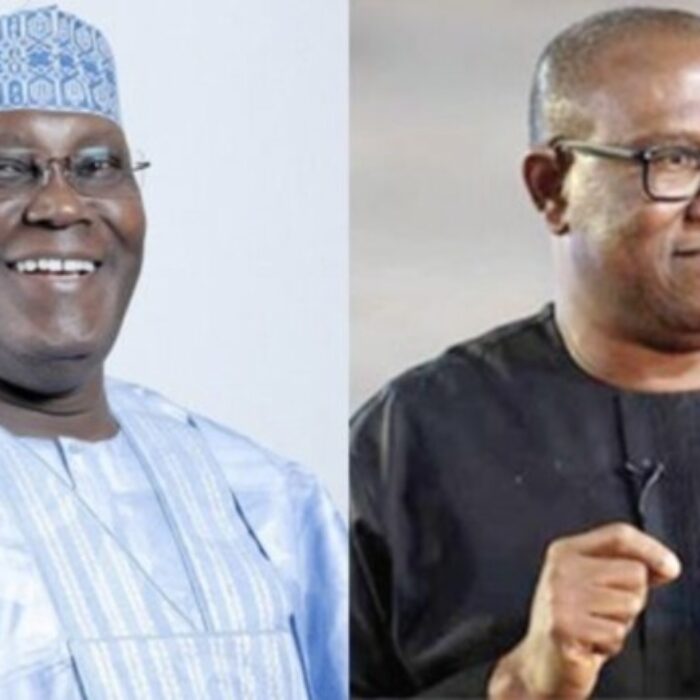
On the first test alone, they are failing. The opposition is in shambles. Obi and Kwankwaso stand frozen like deer in headlights, confused and out of step with each other. They have yet to demonstrate the common purpose required to confront an incumbent this entrenched.
Even within their own ranks, their organisation is fragmenting as Obi’s Obidients, Kwankwaso’s Kwankwasiyya supporters and longstanding indigenous party members fight for control of the campaign and money. Before they can persuade Nigerians to entrust them with the country, they must establish who is in charge of their own campaign. A house this divided is too weak to win a national election.
Atiku is a bulldog that barks loudly but has no teeth left to bite. His anger has become a substitute for a winning strategy. He spends too much time litigating and digging for political dirt, and too little building a coalition, organising voters and explaining how he would govern. He owes Nigerians a clear account of what his presidency would deliver and how he intends to pay for it. Another court filing or allegation against Tinubu will not answer those questions. Atiku must give voters a reason to trust him with power. His determination to discredit Tinubu is no substitute for earning that trust.
Each opposition camp demands that the others recognise its candidate as the answer. None has explained how dividing the opposition vote will remove Tinubu. Not one of these camps sees a reason to unite against the incumbent, and the explanation is simple: they can read the tide, and it is running against them.
The electoral arithmetic punishes that division. They will cannibalize each other’s votes. They compete for the votes they need to combine, subtracting from one another’s strength and handing the incumbent the advantage. Tinubu does not need to win over their supporters if their separate ambitions keep those votes scattered. Joining forces is their only route to a competitive race. Without a united opposition, it is game over.
They know that staying divided makes Tinubu’s re-election easier. Yet each would rather risk another four years of his government than step aside for another opposition candidate. They ask Nigerians to endure hardship, organise and vote, while treating their own ambitions as non-negotiable. The families desperate for relief are being asked to sacrifice again so that no candidate has to. This is selfishness at the expense of the very people they claim they want to rescue.
They are spending the few days left arguing over whether INEC will conduct a fair and transparent election while neglecting the work of getting more Nigerians to the polls and giving them a credible, compelling reason to vote for someone other than Tinubu. Yes, INEC must conduct an election free of rigging. Every vote must count. But the opposition cannot run INEC from a press conference, and repeating its suspicions will not build a winning campaign.
The opposition must unite, get its supporters to the polls and give Nigerians a convincing reason to vote for change. That work is theirs. INEC will not settle their rivalries, organise their campaigns or explain how their policies will improve people’s lives. They have failed at each of these tasks. They must answer for those failures instead of blaming INEC for work they have refused to do.
Even when they have the public’s attention, they waste it. Rather than tell Nigerians what will change under their leadership, they repeat the same stale complaints about the country’s problems and Tinubu’s failures. Nigerians know these problems. They live with them every day. They want solutions.
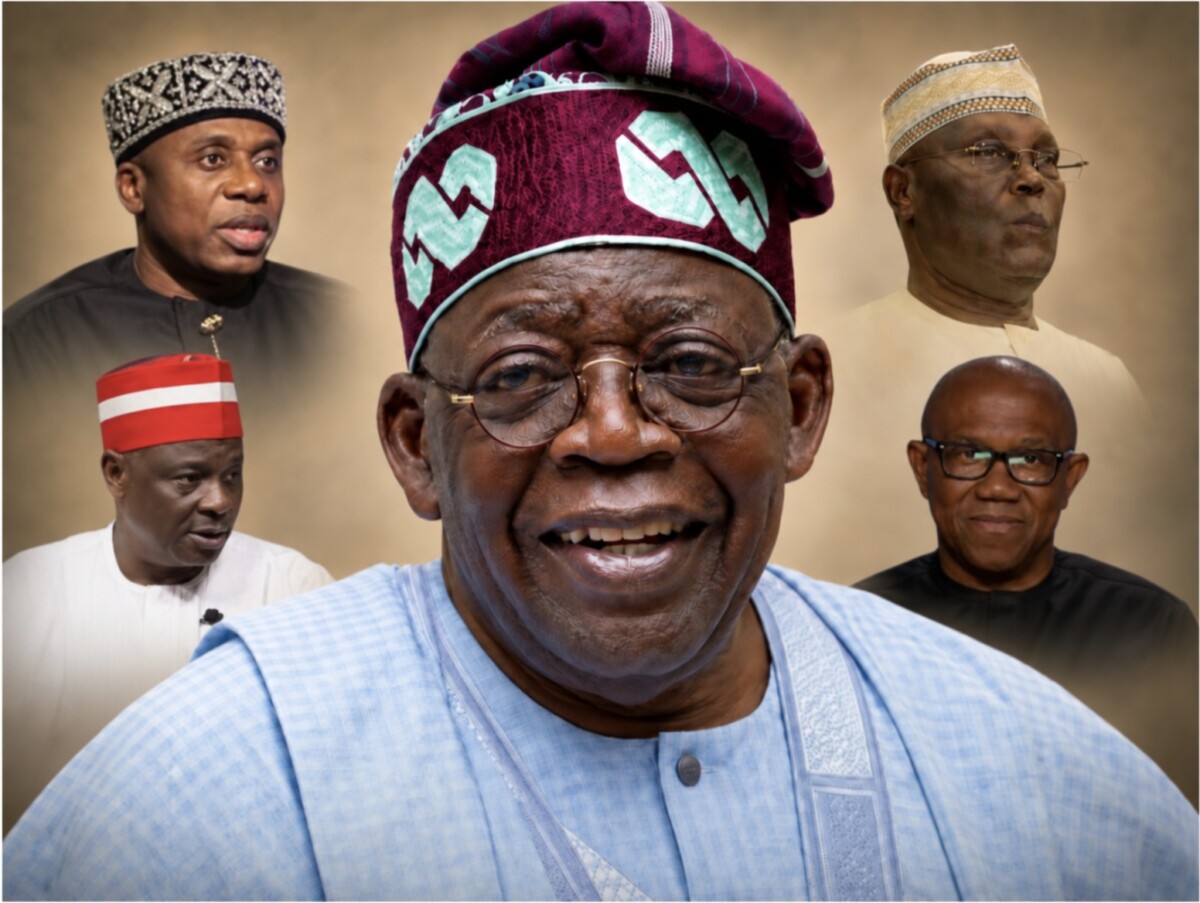
Obi and Kwankwaso, Atiku and Amaechi, what will you do to bring down the cost of food, transportation, medicine, school fees and rent? How will you keep Nigerian families safe? If removing the fuel subsidy was wrong, will you restore it? In what form, and how will you pay for it? If you blame Tinubu’s monetary policy for the naira’s collapse against the dollar, what will you change, and why should Nigerians expect your policy to strengthen it?
These are the questions that keep our families awake at night. Answer them. Explain what you will do, how you will do it and how long Nigerians will have to wait for relief.
To hell with Tinubu’s age, schooling, certificates and drug accusations. To hell with who got which appointment. To hell with the tribal baiting. To hell with another speech listing grievances Nigerians already know by heart. They cannot feed their children on your allegations or pay their rent with your outrage. You want their votes. Tell them what you will do, how you will pay for it and when they will see results. Their hardship is not material for your next attack on Tinubu. It is the problem you are asking to be elected to solve.
By refusing to explain how they would solve it, the opposition makes Tinubu’s campaign easier. He faces opponents who spend their time repeating accusations and fighting one another while leaving voters without a convincing alternative. Every quarrel weakens their ability to challenge him.
Every refusal to compromise keeps votes divided. Every speech without a credible proposal wastes another chance to persuade Nigerians that a change of government would improve their lives. They have made such a mess of this challenge that voters are entitled to ask whose election these men are working to win.
That is what feeds the suspicion that parts of the opposition are quietly working for the incumbent. Take that for what it is worth. Whatever their private intentions, their public conduct serves him. Tinubu could hardly ask for more cooperative opponents.
There are 100 days until the election, but the opposition must make its case before December’s Christmas and New Year distractions. That leaves the rest of October and November to give Nigerians a clear answer: how will your government make food affordable, restore their purchasing power and keep their families safe?
How their answer will determine whether Nigerians see a government worth electing or another set of selfish politicians demanding their turn. The opposition must give voters something to vote for beyond their hatred of Tinubu.
There is still time to unite and make that case. Atiku and Amaechi, Obi and Kwankwaso, must decide what they are prepared to sacrifice to give Nigerians a better government. They cannot keep asking struggling families to sacrifice while refusing to surrender a single personal ambition. If that refusal helps return Tinubu to office, they will have to answer for it. They cannot spend another four years condemning a presidency they helped preserve.
**About the Author*
Nnaoke Ufere is a leading voice in African public thought and policy. He writes a weekly opinion column for the African Mind Journal, where his work shapes national conversations on leadership, governance, and reform. He is the author of Covenant With Nigerians: Reversing Our Country’s Decline and the forthcoming book Creative Destruction: A Radical Blueprint for Making a New Nigeria.
Ufere graduated from the University of Nigeria, Nsukka, in 1981 with a first-class honours degree in Electrical/Electronic Engineering. He earned his MBA at Harvard Business School, where he was a Heinz Fellow, and his PhD in Strategic Management at Case Western Reserve University. He received the Best PhD Dissertation Award from the International Academy of Business and Management.
Ufere is a tech entrepreneur and venture capitalist, influential author, public intellectual, and global development analyst whose insights on U.S.-Africa relations and institutional accountability continue to challenge the status quo and inspire change.