By Nnaoke Ufere, PhD*
On November 1, 2025, President Donald Trump sent shockwaves across the world when he posted on his social-media platform that if the Nigerian government “continues to allow the killing of Christians, the U.S.A. will immediately stop all aid and assistance to Nigeria, and may very well go into that now disgraced country, guns-a-blazing, to completely wipe out the Islamic terrorists.”
I penned an open letter to both Presidents, calling for de-escalation, unity, and a shared commitment to justice and cooperation to end the senseless killings in Nigeria. In it, I warned against using the terrorist insurgency and the tragic deaths of Christians as a pretext for foreign intervention in Nigeria’s domestic affairs and politics. Only Nigerians can ultimately resolve the Boko Haram crisis, though diplomatic pressure and technical support from international partners remain essential. The response to the letter has been overwhelmingly supportive, resonating with readers across the globe.
Today, however, I am particularly struck by one element in President Trump’s post, where he referred to Nigeria as a “now disgraced country.” What exactly did he mean by that, and what message was he trying to send to President Tinubu, Nigerians, and the international community?
Drawing from credible sources in Washington, this essay seeks to unpack the implications of that statement, examining its political undertones, moral weight, and the broader reflection it casts on Nigeria’s current state.
More crucially, it considers what the statement signifies for President Tinubu’s leadership and tenure. The analysis also explores how the language of global leaders can shape international perceptions of Nigeria, influence foreign policy toward our nation, and challenge the authority and legitimacy of President Tinubu’s leadership.
“Now Disgraced Country”
The phrase “now disgraced country” carries a weight of meaning that has been largely overlooked by the press and commentators, both in Nigeria and around the world. It is a phrase that demands reflection, not dismissal. It is not simply a passing insult or a careless provocation. Rather, it is a statement heavy with judgment that forces us to ask how and why our country has come to be seen this way.
Indeed, President Trump said out loud what many world leaders whisper in private conversations about Nigeria. In diplomatic circles, the same disappointment, frustration, and disbelief often echo behind closed doors—the disbelief that a nation so rich in talent, natural resources, and potential could be so consistently betrayed by its own leaders.
Seen in this light, Trump’s remark was more than just another outburst. It was a global rebuke and a direct challenge to the credibility of our government and the integrity of our leadership.
When he called Nigeria “a now disgraced country,” he was not attacking the Nigerian people, according to diplomatic observers familiar with U.S.–Nigeria relations. He was indicting the failures of those entrusted with the responsibility to uphold good governance, security, and national integrity.
The word “now” implies that whatever triggered the “disgrace” is unfolding in the present or has only recently occurred, at least in Trump’s view. He is drawing attention to contemporary events or policies that, in his framing, justify such a harsh label.
As one senior administration insider observed, this sense of disgrace extends beyond the tragic killings that trigged his post to encompass a broader pattern of leadership failure, corruption, and policy blunders which the Trump administration and millions of impoverished Nigerians view as a strategic and humanitarian disaster.
According to a top official familiar with U.S.–Nigeria policy discussions, Trump was condemning the man he sees as the architect of our nation’s decline, the leader whose decisions have plunged the country deeper into crisis and disgrace: President Bola Ahmed Tinubu.
And yet, the greater tragedy does not lie in Trump’s disgraced country rebuke, but in how deeply it resonates. Our shame is not in being condemned by a foreign leader, but in the reality that we have given the world so many reasons to agree with him.
Tinubu’s Disgrace
Soon after Washington clarified that the comment referred specifically to Tinubu’s incompetence and his failure to confront the violence tearing through our land, it became clear that Tinubu is in Trump’s crosshairs.
Whether we agree with Trump or not, the truth is difficult to escape. Our reputation as a nation has been stained by the weakness of Tinubu’s leadership and his inability to address our most pressing problems, including the terrorist murderers rampaging across parts of the country.
The world no longer looks at Nigeria with respect and hope. Instead, they see a country adrift, broken by corruption, mismanagement, mediocrity, insecurity, and incompetence.
This perception has been years in the making, and while Tinubu is not solely to blame, his administration has certainly made it worse. It is the inevitable outcome of years of failed governance, moral decay, and the systematic dismantling of public accountability.
But Tinubu’s disgrace is more than a personal failing; it reflects what we as a people have allowed ourselves to become when tribe, religion, and status determine our sense of right and wrong, influence who we vote for, and make failure seem normal. It is the mirror that compels us to confront our silence and complicity.
Yet Tinubu’s failure is not his alone. It exposes a deeper national rot, a moral and civic collapse that has corroded the soul of our nation. Our nation is disgraced when:
- Funds meant to build schools, hospitals, housing, roads, electricity, clean water, and security and to invest in our people are looted, embezzled, and misappropriated by corrupt politicians and bureaucrats.
- Our leaders enrich themselves while 80% of our citizens are impoverished for life.
- Millions of our children go to bed each night hungry, and millions of families do not know where the next meal will come from.
- The rich educate their children in private schools and foreign institutions, while the vast majority of Nigerian children are trapped in crumbling classrooms where teachers don’t teach and students don’t learn.
- The wealthy seek treatment in London and Dubai, while ordinary Nigerians are left to perish in collapsing hospitals without medicine, equipment, or mercy.
- Terrorists, insurgents, bandits, kidnappers, and assassins roam our communities, while the elite live behind high walls guarded by private security, untouched by the fear that stalks ordinary Nigerians.
- In the twenty-first century, in an oil-rich country, electricity supply remains unreliable and darkness defines daily life.
- Our best and brightest leave for foreign countries in search of opportunity, while our hospitals, universities, and industries decay without their expertise or energy.
- Elections are rigged; our votes don’t count, and incompetent politicians hold power while democracy erodes.
- Corrupt politicians are incentivized to defect from the parties they were elected under to the president’s party for protection and personal gain.
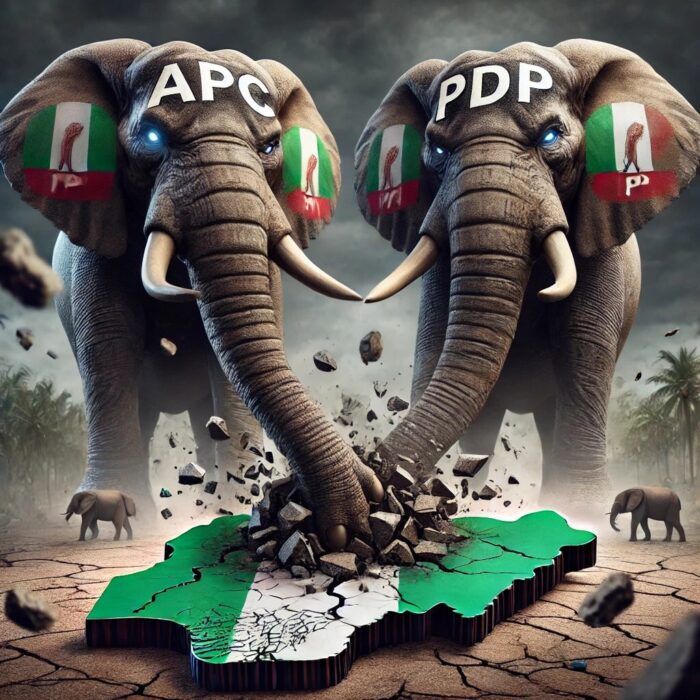
- Only the North and Southwest, through political fiat and control of the APC and PDP, are allowed to produce the president, while other regions with capable leaders are sidelined.
- Women are systematically excluded from power, reduced to symbols, and denied the dignity and influence they deserve in both politics and society.
- Tinubu’s top government appointments reward loyalty over competence, serving personal allegiance rather than the urgent task of solving the nation’s problems.
- Failed leaders like Tinubu, Atiku, Jonathan, and others are recycled every election cycle as the only choices for president, and that itself is disgraceful.
Our disgrace is therefore not born of poverty or lack of potential. It is born of moral compromise and leadership without conscience. Until we confront that truth as a people, no foreign power, no amount of aid, and no rebuke from abroad will restore our dignity or heal our wounds.
The Crisis of Leadership
Our national crisis is, at its core, a crisis of leadership, a collapse of courage, character, and conviction at the highest levels of government.
Yes, President Tinubu inherited a wounded country, but instead of healing it, he has deepened its pain. Under his watch, the poor have become poorer, and the middle class has nearly vanished. Prices rise daily while wages remain stagnant.
Corruption thrives openly, and impunity has become the reward for loyalty. Instead of offering a vision that unites us and keeps our communities, schools, and farmers safe, his government fuels division, silences dissent, and pretends that all is well.
The tragedy is not only that our leaders have failed us, but that too many of us have accepted failure as normal. We have become a nation conditioned to endure rather than to demand.
When politicians steal, we shrug. When elections are rigged, we move on. When our children die from hunger or lack of healthcare, we say, “That is Nigeria for you.” But it does not have to be this way.
We must begin to expect more from those who lead us. We must remember that democracy is not a gift from politicians; it is a responsibility we share as citizens.
A nation cannot rise above the character of its leaders, but neither can it rise above the complacency of its people. If we continue to look away, then we are accomplices in our own decline.
Tinubu’s government represents everything that has gone wrong with our politics: the elevation of loyalty over competence, the obsession with control over compassion, and the celebration of survival over service.
Power has become an end in itself rather than a means to lift our people from despair. Under this model, the state exists not to protect the weak, but to preserve the powerful.
We must reject his idea of Nigeria. We must believe again that government can be honest, that justice can be blind, and that leadership can still mean service. Our country will not change because America speaks or because Trump threatens. It will change when Nigerians, united in purpose and conscience, decide that we have had enough of incompetence, deception, and disgrace.
The Path to Redemption
The path to redemption for this administration does not begin with pandering to Mr. Trump. Yet Tinubu’s handlers are prematurely celebrating a supposed G20 meeting between him and Trump, even though no such meeting has been confirmed. In fact, Washington appears unaware of any face-to-face engagement on the schedule.
But does Tinubu truly want a televised encounter with Trump? It would certainly make for spectacular viewing — though likely at the expense of national dignity. Such an exchange could easily turn into an embarrassing spectacle and a blow to our country’s image.
The prudent course, for now, would be to avoid a public meeting altogether. If communication is necessary, a discreet phone call would spare everyone further humiliation. One only needs to revisit past Oval Office televised confrontations for evidence of how these situations can unfold.
If we are truly to redeem our nation, we must first confront the truth of what we have become: a disgraced country. Our redemption begins with the truth that Nigeria is broken, but not beyond repair.
We must stop waiting for miracles and start building them ourselves. Those who look to Trump as a savior will wait in vain. He is not coming to save Nigeria, and neither is America. The United States no longer needs our oil, and Nigeria has no rare-earth minerals to bargain with. To the world’s powers, we are expendable.
Change will not come from foreign capitals or from those who profit from our misery. It will come from citizens who refuse to remain silent, from Nigerians who choose courage over cynicism, and action over apathy.
It begins with the recognition that power belongs to the people, not to the politicians who misuse it. It begins when we learn to see our challenges for what they are, failures of leadership and accountability, not battles of tribe, religion, or region. Every act of courage, every honest vote, and every voice that speaks truth to power brings us closer to the nation we were meant to be.
Trump, who still claims to be a victim of a rigged election in his own country, has vowed to confront electoral fraud wherever he sees it. So, Trump and the world will be watching Nigeria’s 2027 election with keen interest — that much is clear from his statement.
Any attempt to rig that election will face opposition both at home and abroad. The will of the people must prevail, for regime change through the ballot is always better than change through chaos. Our leaders must understand that legitimacy can no longer be manufactured; it must be earned through genuine votes and sustained by justice.
To my fellow Nigerians, let us not wait for another foreign leader to tell us who we are. Let us define ourselves by our actions, not our excuses. Let us reclaim the name Nigeria so that it no longer stands for disgrace, but for dignity. We cannot continue to hide behind the excuse that “things will change.”
Nothing changes until someone decides that enough is enough. The moment we stop accepting mediocrity, our healing will begin. The day we stop glorifying corrupt leaders, our nation will start to rise.
Our nation cannot rise above the character of our leaders, but neither can it rise above the complacency of our people. Each time we look away, we enable decline.The time we refuse to sell our votes for money, our democracy will begin to breathe again.
To President Tinubu, you have only two more years to change course. The patience of our people is wearing thin, and the world is watching. Trump’s statement, whatever its motives, is a warning that includes all options. The tides of accountability are rising, and time is running out.
Nigeria cannot afford more chaos or suffering. This is why, Mr. President, you must demonstrate courage, confront the rot within your administration, and respond to the nation’s crisis with the urgency, resolve, and results that leadership demands. Otherwise, step aside for those prepared to do so.
*About the Author
Nnaoke Ufere is a leading voice in African public thought and policy. He writes a weekly opinion column for the African Mind Journal, where his work shapes national conversations on leadership, governance, and reform. He is the author of Covenant With Nigerians: Reversing Our Country’s Decline. Nnaoke graduated from the University of Nigeria, Nsukka with a first class honors degree in Electrical/Electronic Engineering in 1981. A Harvard MBA alumnus and PhD holder in Strategic Management from Case Western Reserve University, Ufere is an influential author, public intellectual, and global development analyst whose insights on U.S.-Africa relations and institutional accountability continue to challenge the status quo and inspire change.