By Nnaoke Ufere, PhD
Nigeria was built to function as a multiparty democracy, a principle enshrined in our constitution, defended through decades of struggle, and upheld, however imperfectly, since 1999.
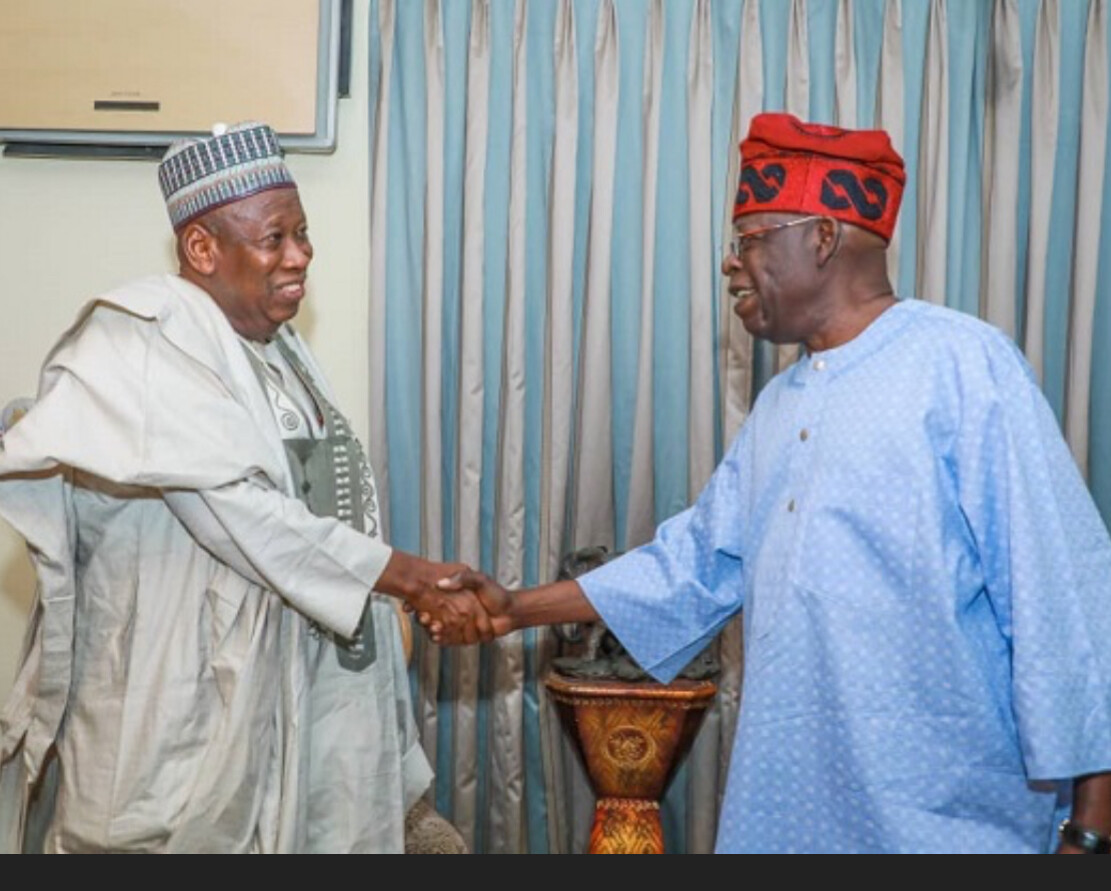
Today, that democratic promise is under siege. Driven by the ambition of two out-of-touch and power-hungry men, Abdullahi Ganduje, the APC’s notorious political enforcer known for engineering cold-blooded tactics of coerced defections and opposition sabotage, and President Bola Tinubu, propelled by unchecked ambition, Nigeria’s democratic foundation is being methodically dismantled with ruthless indifference.
Tinubu and Ganduje portray these defections and implosion of the opposition as evidence of their party’s growing popularity and national unity. But they know full well this is not about democratic appeal, it’s about tightening control. Behind the scenes, their aim is to build a one-party system where they alone decide who holds power, who gets silenced, and who gets rewarded.
According to insider accounts and their recent political conduct, their objective is not to govern through consensus, but to impose a one-party regime where opposition isn’t defeated at the ballot box, but dismantled through coercion, absorption, and sabotage secured by patronage, political favors, and entrenched corruption.
This calculated power grab by two corrosive figures is not only reckless but also obsolete and unsustainable. The sun has set on Ganduje and Tinubu. Their era of shadowy manipulations and predatory politics is over, and Nigeria must not remain captive to men whose destructive instincts and political baggage now pose a threat to the nation’s future. Their hold on power reflects the past, not the future. Nigeria cannot move forward while clinging to men who treat a nation of over 200 million as their private estate.
The consequences of their one-party ambition are already on full display. Defections from opposition parties are not the result of persuasion or shared ideology and vision; they are orchestrated through intimidation, inducements, and pressure tactics deployed by APC operatives. Internal dissent is equally unwelcome.
Even within their own ranks, dissent is not tolerated. Vice President Kashim Shettima is allegedly being quietly sidelined for daring to question the direction in which Tinubu and Ganduje are dragging the country. His protest against the creeping authoritarianism, and disregard for internal party democracy has made him a political liability in a system where absolute loyalty is demanded and independent thought punished. This is not a functioning democracy; it is a political cartel tightening its grip, even at the expense of its own.
Most alarming is the insidious use of federal power to stage political coups disguised as emergency interventions. In Rivers State, the federal government has brazenly inserted itself into a state-level crisis, not to resolve conflict, but to seize control of the entire state apparatus.
Under the cover of mediation, the administration is dismantling local autonomy and replacing it with party loyalty, establishing a dangerous precedent for authoritarian overreach nationwide. As previously reported in this Journal, APC operatives are allegedly at work in Abia and Anambra states.
This manipulation extends deep into the machinery of governance. In today’s co-opted state, the National Assembly, law enforcement agencies, the military, establishment media, and the judiciary increasingly serve partisan ends, all with one objective: total political dominance, according to multiple APC officials who spoke on condition of anonymity to discuss internal dynamics of the administration.
One by one, the checks and balances meant to restrain power are being weakened, bypassed, or captured by the administration and Ganduje. What remains is a system increasingly tilted toward authoritarian control under Tinubu, with no room for opposition, scrutiny, or accountability.
Nigeria is Not China
Ganduje, unconcerned with even the pretense of democratic values, has been the most outspoken about this agenda. He recently cited China to justify a one-party direction, stating, “China runs a one-party system, and it works for them.”
The comparison is revealing. In China, dissent is criminalized, the judiciary is subservient to the ruling party, independent media is outlawed, and mass surveillance controls the population. Ethnic and religious minorities are subjected to systemic repression. Yet Ganduje overlooks all of this while holding up the same model as a blueprint for Nigeria.
The parallel collapses when Nigeria’s diversity is considered. China’s society is relatively homogenous, while Nigeria is a federation of many ethnicities, religions, and cultures. A single-party framework in our plural nation would not merely be authoritarian; it would be dangerously unstable. Effective governance in Nigeria demands consensus, inclusion, and genuine pluralism, not rigid dominance by one party of like-minded aging elites.
The Existential Threat of One-Party Regime
The threat of a one-party regime is not just a political concern. It is a systemic danger. When one party rules without credible opposition, as we are now witnessing, accountability collapses, corruption thrives, and public policy is no longer shaped by competence or the needs of the people, but by loyalty and patronage.
The consequences are already visible across the country: rising inflation, mass unemployment, deepening poverty, widespread insecurity, collapsing public trust, and a wave of protests born out of frustration and despair.
Yet rather than confront these crises, the ruling APC seeks to consolidate the very power that created them. A one-party state led by the same political machine that drove Nigeria into this crisis will not bring recovery. It will entrench the rot.
You cannot expect an arsonist to extinguish the fire he set. A looter cannot safeguard the treasury. An embezzler cannot build accountability. A government built on repression, exclusion, and greed cannot deliver justice, unity, or reform.
This is why the push for one-party dominance is not just a policy misstep. It is a direct attack on the nation’s identity. Nigeria has never been a land of one voice. Our strength lies in our diversity: competing visions, regional identities, cultural pluralism, and a tradition of vibrant civic debate.
True democracy provides space for these differences to coexist, to clash, and to ultimately find common ground. To impose political uniformity through coercion is not only unjust. It is fundamentally un-Nigerian. And if allowed to continue, it will break the nation apart.
We Must Defend Multiparty Democracy
Multiparty democracy was designed precisely for countries like Nigeria. It reflects our complexity, distributes power more equitably, and offers citizens real choices. Any attempt to convert this system into a political monopoly is not only undemocratic. It is reckless and destabilizing.
Nigeria cannot move forward while dissent is silenced and political alternatives are erased. A government that fears opposition, as Tinubu’s administration clearly does, undermines the very foundation of the republic it claims to lead.
This is why the real divide in Nigeria today is not APC versus the opposition. It is democracy versus despotism. What is at stake is whether political power remains with the people or is hoarded by a few. And the moment to choose is not some future election. It is now, while there is still space left to resist, before the last defenses of democratic accountability are stripped away.
That choice grows more urgent by the day. Every defection falsely paraded as “alignment” is one more step toward eliminating political competition. Every court judgment tilted to favor the ruling party chips away at the rule of law.
Every opposition voice silenced, sidelined, or bought sends a clear signal. Power in this system is no longer earned by persuasion or performance. It is preserved through fear, bribery, and manipulation. This is how democracies fall, not with a bang, but with a series of calculated erosions.
And the signs are familiar. We have seen this pattern before, under military regimes where dissent meant detention or death, and in civilian governments that bent institutions to serve personal ambition. What makes today’s threat even more dangerous is its disguise. Autocracy is dressed in the language of unity. Centralization is sold as stability. Domination is masked as national interest.
This is why the role of independent institutions is more critical than ever. The media, civil society, and opposition parties cannot afford silence. Silence is not neutrality. It is complicity. Editors, union leaders, youth movements, students, teachers, farmers, religious organizations, women’s groups, traditional leaders, and community assemblies must speak out. Not for partisan advantage, but to preserve the very possibility of free political expression.
The courts must reclaim their independence. The National Assembly must remember that its duty is to the people, not to the presidency. The military and law enforcement exist to serve the public, not the personal interests of those in power.
Above all, ordinary Nigerians must not surrender to fear or apathy. Hope means nothing without action. Authoritarianism takes root when citizens like us fall silent. But history shows that when people rise to protest, organize, vote, and demand accountability, even the most entrenched powers can be challenged. Systems can change. Democracy can be defended.
Today, our democracy is not under siege by tanks or decrees. It is being attacked by more insidious forces: manipulation, intimidation, and the slow erosion of democratic norms. Whether it collapses or survives will depend not just on institutions, but on the willingness of our citizens to resist.
What the country needs now is not more political strongmen or recycled elites. It needs a new kind of leadership that is visionary, competent, energetic, and accountable. Leaders who will strengthen democratic institutions, restore integrity to governance, and put the public interest above personal gain.
For that future to emerge, Ganduje and Tinubu must step aside. Their time is up. Nigeria cannot move forward while it remains hostage to leaders who are out of touch, consumed by power, and unwilling to change.