A structural analysis of vote distribution, geographic spread, declining turnout, and the constitutional path to victory in 2027
Nnaoke Ufere, PhD*
Executive Summary
President Bola Tinubu may be one of the most unpopular incumbents in Nigeria’s democratic history. Under his administration millions of Nigerians have watched their purchasing power collapse under soaring inflation, a sharply weaker naira, rising unemployment, growing insecurity, and an unprecedented cost of living crisis.
Yet despite widespread public discontent and dissatisfaction, Tinubu remains the statistical favorite to win reelection in 2027.
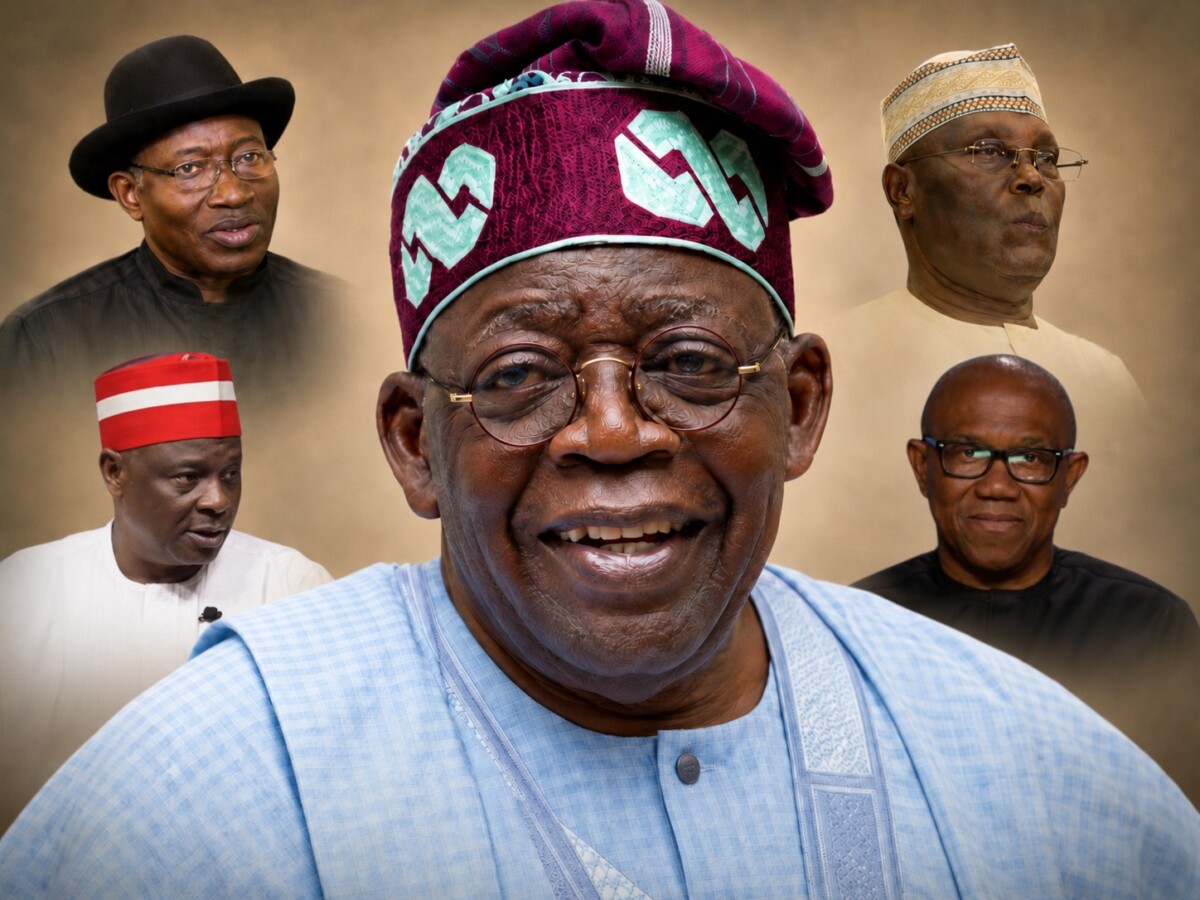
The reason is not that Nigerians have embraced his dismal record. It is that the self-centered ambition of opposition candidates has once again taken precedence over the national interest. The tragedy of Atiku Abubakar, Peter Obi, Rabiu Kwankwaso, and Goodluck Jonathan, if he runs, is that each appears foolishly and self-deludedly convinced that only he can lead Nigeria.
This paper advances a single and defensible proposition. Barring major unforeseen events that materially alter the political landscape, Tinubu has an estimated 65 percent probability of winning the 2027 presidential election outright. Prolonged hardship does not automatically produce electoral defeat. In a long-suffering society, public anger can coexist with resignation, declining turnout, vote selling, and weakened faith in elections, allowing an unpopular incumbent to prevail without majority public support.
Four forces support this conclusion.
First, the opposition is divided among multiple presidential candidates rather than united behind one.
Second, the challengers who posed the greatest threat in 2023 have surrendered the party infrastructure that made them formidable. Their 2023 votes will not automatically transfer to new political platforms because party organisation, polling-unit agents, and grassroots structures matter as much as personal popularity.
Third, voter turnout, which has declined progressively since 2009, is more likely to fall again than recover. Lower turnout disproportionately benefits incumbents with the financial resources and political machinery to identify, mobilise, and turn out their supporters.
Fourth, Tinubu enjoys the full advantages of incumbency. These include enormous financial resources, control of the federal government, the support of a majority of state governors, an extensive nationwide grassroots organisation, and, as many critics contend, effective control of INEC and the judiciary. Whether exercised through formal authority, political influence, or institutional alignment, these advantages strengthen his capacity to secure reelection despite widespread public disapproval.
On the central case developed below, Tinubu secures roughly 40 percent of a shrinking electorate, satisfies the constitutional spread requirement, and defeats a divided opposition.
Atiku, Obi, and Kwankwaso learned nothing from 2023
In 2023, blinded by raw personal ambition, each believed he could win alone and refused to step aside. The result was predictable: they divided the opposition vote and handed Tinubu the presidency with less than 37 percent of the national vote. They are now preparing to repeat the same failure in 2027. They know that none of them can defeat Tinubu in a crowded field, yet they remain unwilling to make the sacrifice required to unite behind a credible independent candidate.
This is not merely political miscalculation. It is a refusal to place Nigeria above self. Their personal ambitions now matter more to them than the hardship, insecurity, and economic decline endured by millions of Nigerians.The consequence is clear. A fragmented opposition makes it possible for an unpopular incumbent to win re-election without majority public support. The political elite benefits. Ordinary Nigerians pay the price.
More than 230 million Nigerians should not have their future determined by the ambitions of Atiku, Obi, Kwankwaso, and Jonathan. Leadership requires the willingness to subordinate personal aspiration to the national interest. Nigeria’s opposition has so far refused to do so.History will be harsh on Atiku, Obi, Kwankwaso, and Jonathan if he runs. Never have so few selfish men held the fate of so many Nigerians hostage to their personal ambitions. If their refusal to unite returns Tinubu to office, they will bear direct responsibility for the consequences.
The consequences of that refusal are not merely political or moral. They are measurable. A divided opposition reshapes the vote, weakens each challenger’s geographic spread, lowers the threshold Tinubu must reach, and magnifies the advantages of incumbency. The structural analysis that follows shows how these forces combine to make his reelection the most likely outcome.
1. Assumptions and Method
This is a structural scenario model, not a forecast. It reasons from the stated parameters and fills the gaps with explicit, defensible assumptions. Its purpose is to expose the mechanics that will govern the result rather than fix a precise figure, since fraud, collation manipulation, and turnout can move any bloc by two to three million votes.
Fixed parameters
- Registered voters: 90 million.
- Threshold to win: a plurality of the national popular vote, together with at least 25 percent of votes cast in two-thirds of the states, meaning no fewer than 25 of the 36 states and the Federal Capital Territory.
- Field: Tinubu against a three-way opposition of Obi-Kwankwaso, Atiku, Jonathan, with Jonathan’s candidacy uncertain.
Working assumptions
- Turnout is treated as falling. Participation has declined progressively since 2009, so the prior cycle’s 27 percent is now a ceiling rather than a floor. The central case adopts roughly 24 percent, giving about 21.6 million votes cast, with a sensitivity range presented in Section 4.
- Incumbency machinery, the support of 32 state governors, and entrenched vote-buying convert political structure into votes even where public approval has collapsed. In a fraud-prone system, control of collation and rural mobilisation matters more than sentiment. Economic hardship almost certainly costs Tinubu a meaningful share of his 2023 supporters. The central assumption of this paper, however, is that those losses are substantially offset by incumbency, campaign financing, governors, defections, local party structures and vote-buying capacity. In other words, his organisational strength compensates for declining popularity.
- Party infrastructure, meaning the ward and polling-unit agents who defend ballots at collation, is frequently more decisive than a candidate’s personal appeal. Votes that cannot be defended are votes effectively lost.
- Lower turnout structurally favours the incumbent. Paid and mobilised votes are largely turnout-inelastic, whereas the fragile protest vote is precisely the category that evaporates when participation falls.
2. The Forces in Play
The fragmentation of the opposition is the incumbent’s single greatest asset. Tinubu’s greatest political advantage is no longer his popularity. It is the inability of his opponents to unite behind one candidate. Elections are not won by popularity alone. They are won by converting support into counted votes. Under Nigeria’s constitutional formula, a divided opposition can hand victory to an unpopular incumbent even when most voters want change.
The extent of that fragmentation becomes clear in the electoral arithmetic. In 2023 the anti-APC vote formed the majority of the electorate, roughly 14.5 million of 24 million cast. In 2027 that majority is divided across multiple candidates rather than gathered behind one, and a divided majority does not win under Nigeria’s rules.
The Obi-Kwankwaso ticket has lost the machinery that carried it. The 2023 Obidient surge was a youth protest movement powered by novelty and, just as importantly, by the Labour Party’s nationwide network of polling-unit agents. That novelty has faded across two party switches, from Labour to ADC and then to NDC, which read as elite manoeuvring rather than movement politics. The ticket now runs on a new platform without the Labour and NNPP structures of 2023. Its agents and collation presence are thin, and thin structure means ballots go uncollected rather than merely lost to a rival.
The alliance also overstates its electoral reach. Kwankwaso strengthens Obi’s position in Kano but does not automatically make an Obi-led ticket competitive across the wider North. His electoral strength outside Kano has historically been limited, and many conservative northern voters may be reluctant to support a ticket headed by Obi. At the same time, not every Obi supporter is necessarily energised by an alliance with Kwankwaso. Electoral alliances do not automatically merge regional voting blocs. They often expose their limits.
The Kano anchor has collapsed. Kwankwaso’s roughly one million votes in 2023 came overwhelmingly from Kano’s Kwankwasiyya machine. With NNPP gone, his protege the sitting Kano governor defected to the incumbent’s camp, and Kwankwaso no longer holds that structure. The governor, government appointees, legislators, local officials and political organisers who helped produce his 2023 result are no longer uniformly under his control. That institutional weakening, rather than any collapse in his personal popularity, is what transforms Kano from a stronghold into a battleground. Kano is no longer securely in Kwankwaso’s column. It is now a genuinely contested state, and a portion of that voting bloc may flow toward Tinubu through the sitting governor.
Atiku has surrendered his greatest advantage. His threat under this constitutional formula never rested on charisma. It rested on the PDP’s robust grassroots infrastructure, which spread his vote across the North and let him clear the 25 percent bar in state after state. Having left the PDP for the ADC, he keeps his personal standing in the North-East and parts of the North-West but forfeits the agent network that converted that standing into geographic reach. His southern running mate lends a modest measure of cross-regional balance, but it does not begin to replace a national machine. Atiku remains a serious name and a diminished force.
The remaining candidates deepen the split. Jonathan, whose candidacy is uncertain, would trade on nostalgia in the South-South without serious machinery. If Duke is not disqualified over the serious election fraud allegations, he remains a marginal candidate who, based on our analysis, is unlikely to have any impact nationwide. Neither candidate can win. Their presence would only further divide the opposition vote and strengthen the incumbent. In practical electoral terms, a vote for Duke or Jonathan is a vote that helps Tinubu.
The ceiling on Tinubu is real but not disqualifying. Because he is genuinely unpopular under sustained hardship, the votes freed by the opposition’s weakness do not simply consolidate to him. Disillusioned voters scatter, abstain, or sell their votes. His floor is defended by money and machinery; his ceiling is capped by resentment. A capped ceiling still wins a fractured field.
3. Estimated Vote Distribution
On the central turnout case of roughly 24 percent, giving about 21.6 million votes cast, the distribution stands as follows. Figures are rounded estimates. Vote shares matter more than absolute totals because the total number of votes contracts as turnout falls.
Estimated votes / vote share:
| Candidate | Estimated Votes | Vote Share |
| Tinubu (incumbent) | ~8.6M | ~40% |
| Obi / Kwankwaso | ~5.8M | ~27% |
| Atiku Abubakar (ADC) | ~3.5M | ~16% |
| Goodluck Jonathan (if he runs) | ~2.0M | ~9% |
| Others / invalid | ~1.7M | ~8% |
| Total cast (90M × ~24%) | ~21.6M | 100% |
Two contingencies deserve note. If Jonathan does not run, his roughly two million votes redistribute unevenly, with the larger portions moving to Atiku and to Obi-Kwankwaso, a smaller share lost to abstention, and a fragment absorbed by the incumbent. That tightens the contest for second place without disturbing Tinubu’s lead. And across every plausible turnout level, Tinubu’s share remains the most stable line in the table, precisely because it depends least on voluntary participation.
4. Regional Vote Estimates
National vote totals alone do not determine the presidency under Nigeria’s constitutional formula. Geographic distribution is equally important. The following scenario estimates illustrate how the projected national vote may be distributed across the six geopolitical zones. They are not polling results but analytical estimates derived from the structural assumptions developed in this paper.
| Region | Tinubu | Obi-Kwankwaso | Atiku | Jonathan | Duke & Others |
| NW | 44% | 18% | 29% | 4% | 5% |
| NE | 37% | 8% | 46% | 5% | 4% |
| NC & FCT | 40% | 26% | 19% | 10% | 5% |
| SW | 55% | 22% | 10% | 7% | 6% |
| SE | 6% | 68% | 4% | 17% | 5% |
| SS | 28% | 28% | 12% | 27% | 5% |
Estimated vote shares within each geopolitical zone under the scenario model, computed to align with the national estimates in the analysis. Each region sums to 100 percent. The figures are directional and illustrate regional patterns rather than predict certified results.
Northwest. The lost Kano anchor shows plainly. Tinubu leads on governor structure, Atiku holds second on residual personal standing, and the Obi-Kwankwaso ticket sits low because Kwankwaso can no longer deliver Kano.
Northeast. Atiku’s one genuine stronghold, reflecting his surviving personal reach even after leaving PDP structure behind.
North-Central & FCT. A genuinely mixed zone. Tinubu edges it on incumbency, Obi-Kwankwaso draw meaningfully from the Middle Belt and Abuja, and Jonathan retains modest reach.
Southwest. Tinubu’s home-base ceiling, where his personal and party structure are strongest.
Southeast. The Obi-Kwankwaso fortress, and the pattern the analysis turns on: enthusiasm that clusters rather than spreads, winning a single zone overwhelmingly while doing little to clear 25 percent in 25 states.
South-South. The closest three-way contest, balancing Tinubu’s incumbency money, Obi’s reach, and Jonathan’s nostalgia, which is why Jonathan peaks here. If Jonathan does not run, most of his share migrates to the Obi-Kwankwaso ticket and Atiku.
Note: Percentages represent estimated vote shares within each geopolitical zone under the scenario model. They illustrate regional voting patterns rather than predict certified election results. Percentages within each region sum to 100 percent.
5. Turnout Sensitivity
Because declining turnout is now a central assumption rather than a footnote, its direction of effect should be stated plainly. Lower participation helps the incumbent, and higher participation modestly helps the opposition, for the simple reason that the incumbent’s vote is manufactured and mobilised while the opposition’s is enthusiastic and therefore fragile.
Turnout scenario / votes cast / effect:
- Low (~22%): ~19.8M — Favours Tinubu most
- Central (~24%): ~21.6M — Base case used here
- High (~27%): ~24.3M — Marginally aids opposition
The asymmetry is the point. There is no turnout level within the plausible range that dislodges Tinubu’s first-place position. Higher turnout narrows his margin; it does not erase it. Lower turnout, the more likely direction given the trend since 2009, widens it.
6. The Decisive Test: Spread, Not Size
The constitutional formula is where this election is truly settled, and it produces a paradox that now cuts against the entire opposition. Victory requires not only the popular vote but 25 percent of votes cast in at least 25 of the 37 units. Distribution beats concentration, and structure delivers distribution.
Tinubu’s advantage here lies in geography rather than popularity. State governors matter more for constitutional spread than for the national vote total. A governor may not make an unpopular president genuinely popular, but a governor can help deliver the 25 percent threshold through local structures, financing, endorsements, mobilisation and political networks. That is precisely what Tinubu requires. He does not need to win every state. He needs only to clear the constitutional threshold across enough states. This, and not his vote total, is the true foundation of his path to victory.
The opposition, by contrast, no longer fields a single geographically efficient challenger. The Obi-Kwankwaso vote concentrates into the South-East, the South-South, and Lagos, and with Kano gone its North-West anchor is lost. Its support is too concentrated to satisfy the spread test even where its share is respectable. Atiku was, until recently, the answer to exactly this problem, because PDP structure spread his vote thinly but widely across the North. Having left that structure behind, he can no longer be assumed to clear the 25 percent bar in the number of states the formula demands.
This is the heart of the matter. The opposition has lost the one candidate whose vote was efficiently distributed, and it has kept the enthusiasm that clusters rather than spreads. Neither remaining challenger reliably meets both constitutional tests. The 32-governor coalition is now the only genuinely national machine in the field, which means the incumbent is the only candidate whose victory the formula readily permits.
7. Outcome Probabilities
Outcome / estimated likelihood:
- Tinubu wins in the first round: ~65%
- Runoff triggered: ~20%
- Contested result / tribunal litigation: ~15% (near-certain regardless of result)
A first-round victory for Tinubu is now the clear central expectation. His spread across 32 governors’ states satisfies both thresholds even at roughly 40 percent and even while he is unpopular, because fragmentation and declining turnout are doing his work for him. The runoff scenario has weakened, since its most plausible trigger was an efficiently distributed Atiku clearing the spread test while the incumbent fell short in a handful of states, and Atiku’s departure from the PDP has closed that path. Given Nigeria’s history of disputed results, tribunal litigation should be treated as near-certain whatever the outcome.
8. Conclusion and Strategic Implication
Every new development points in the same direction. The opposition keeps discarding the structural assets that decide Nigerian elections while clinging to the enthusiasm that does not. The Obi-Kwankwaso merger abandoned the party machinery that made Obi formidable under Labour and Kwankwaso formidable under the NNPP in 2023. Atiku’s move from the PDP to the ADC surrendered the grassroots network that made him geographically dangerous in 2023.
At the same time, declining turnout continues to shift the advantage toward the bought and mobilised vote the incumbent commands. Tinubu’s one genuine liability is his unpopularity, and unpopularity is the one thing this system does not require a winner to overcome.
The strategic implication is unavoidable. The opposition’s greatest threat is no longer Bola Tinubu, but its own refusal to subordinate individual presidential ambition to collective electoral success. Consolidation, not enthusiasm, is what matters. Only a single opposition candidate backed by genuine ward-level organisation and credible national spread can pose a serious threat to the incumbent.
Atiku, Obi, Kwankwaso, and Jonathan should have the decency, patriotism, and self-respect to set aside their egos and act, perhaps for once in their political lives, in the best interest of Nigeria and its citizens. Unfortunately, such sacrifice is rare among Nigerian politicians. Absent that consolidation, Nigerians may witness one of the greatest political ironies in the country’s democratic history: an unpopular president returned to office not because the electorate embraced his record, but because a self-centered opposition handed him the presidency.
Caveat: This is a structural scenario model, not a prediction. Fraud, collation manipulation, and turnout swings can move any bloc by two to three million votes. Figures are reasoned estimates built on the stated assumptions and should be read as directional.
*About the Author
Nnaoke Ufere is a leading voice in African public thought and policy. He writes a weekly opinion column for the African Mind Journal, where his work shapes national conversations on leadership, governance, and reform. He is the author of Covenant With Nigerians: Reversing Our Country’s Decline. Nnaoke graduated from the University of Nigeria, Nsukka with a first class honors degree in Electrical/Electronic Engineering in 1981. A Harvard MBA alumnus and PhD holder in Strategic Management from Case Western Reserve University, Ufere is an influential author, public intellectual, and global development analyst whose insights on U.S.-Africa relations and institutional accountability continue to challenge the status quo and inspire change.