By Nnaoke Ufere, PhD*
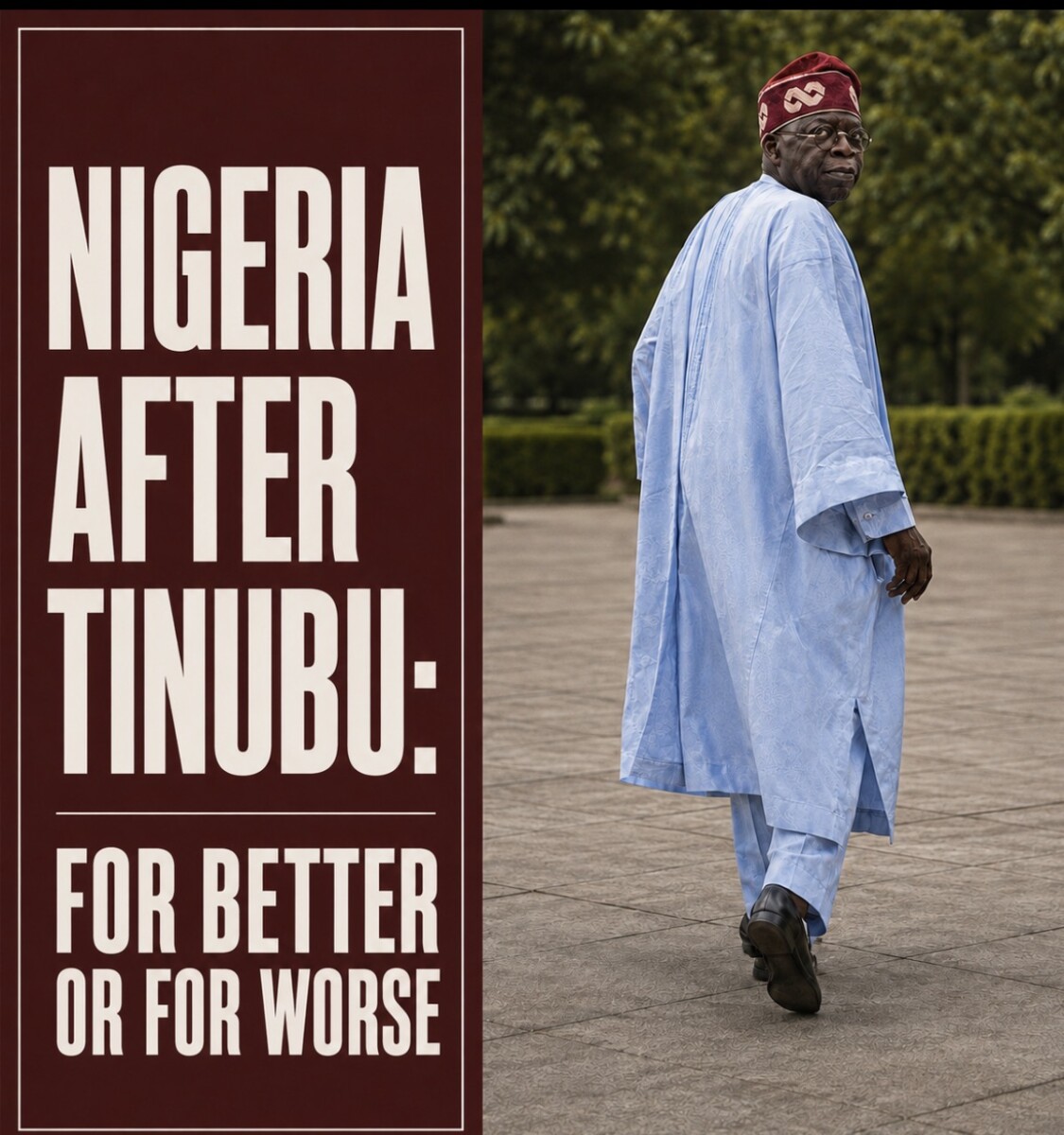
A day will come when Nigerians speak of the country in three political eras: B.T., Before Tinubu; D.T., During Tinubu; and A.T., After Tinubu. For millions, A.T. cannot come soon enough.
Nigeria today is both a disaster zone and a crime scene. Its decline began long before this administration. Successive governments weakened institutions, tolerated corruption and treated the country as private property. But that history cannot excuse policy blunders and mismanagement.
Tinubu inherited a damaged country and made many problems worse through policy failures, misplaced priorities and patronage politics. We were promised reform but too often received greater hardship without evidence of a better country.
What comes after Tinubu? Who can turn the country around? His departure alone will not reverse Nigeria’s decline. Removing a president does not dismantle the political culture, weak institutions and patronage networks that produced him. Nor will a new government automatically revive the economy, create jobs, reduce living costs, defeat terrorists and bandits, restore institutions or rebuild trust.
The period after Tinubu could mark recovery or another chapter of failed leadership. Much will depend on who succeeds him, whether voters reject him in January 2027 or he remains until 2031, and whether that successor confronts the system rather than seizes the same machinery of corruption, patronage and impunity.
Before deciding who should replace Tinubu, we must decide what kind of country that person should build.
Nigeria in 2035
National Vision: Assume Tinubu loses in 2027 and a new president serves two terms. By 2035, the basic functions of government should work to the benefit of all Nigerians.
Economy and Employment: The economy should grow by at least 6 percent a year beyond oil. At least two-thirds of working-age Nigerians should have productive employment, with youth unemployment and underemployment in single digits. Entrepreneurs and small businesses need credit, predictable and less taxes and clear regulations.
Inflation and Food Security: Inflation should remain below 7 percent and incomes rise faster than prices. Nigeria should feed itself. Farmers need land, irrigation, storage, credit and rural roads. Acute food insecurity should fall by at least 80 percent.
National Security: Nigerians should travel, farm, work and attend school without fear of kidnapping, terrorism or violent crime. Kidnappings and deaths from organized violence should fall by at least 90 percent. Every local government area should have trained security personnel. Kidnappers and bandits convicted of these crimes should face the death penalty, not “rehabilitation.”
Electricity and Infrastructure: Electricity should reach at least 95 percent of the population, with no less than 50,000 megawatts of dependable power. Roads should be safe, railways should connect ports, farms and cities, and goods should clear ports in days, not weeks. Logistics costs and road deaths should fall by half.
Healthcare and Education: Every Nigerian should have access to basic healthcare without financial ruin. Maternal mortality should fall below 100 per 100,000 births and under-five mortality below 25 per 1,000. Out-of-school children should fall by 90 percent, with basic literacy and mathematics standards met by age ten.
Transparency, Accountability and Corruption: Major federal contracts should use open electronic procurement. Senior officials’ asset declarations should be public and verified. Anti-corruption agencies should have protected funding and authority to investigate anyone.
We should no longer judge corruption by press conferences, selective arrests or opponents dragged before the courts. The test is whether powerful governing-party members face the same investigation, prosecution and punishment as everyone else. Any government that shields corrupt allies while pursuing opponents has failed. Nigeria should impose the death penalty on anyone convicted of serious corruption, regardless of wealth, status, political affiliation or connections. There can be no protected class or political exemptions.
Institutions and Measurement: Courts should be independent, INEC should conduct credible elections, police should enforce the law, and appointments should be based on competence. The civil service should function when governments change. These goals should be published in 2027 with annual targets and independently verified progress reports.
That is the standard: a safer, productive and accountable Nigeria where government performs its duties and citizens no longer depend on one man in Aso Rock. Anything less after eight years would be another wasted presidency.
What stands in the way is clear: corruption, insecurity, weak institutions, ethnic politics, wasteful government, economic mismanagement, electoral manipulation and politics built around state resources. These failures reinforce one another and turn politics into a struggle for wealth rather than service.
The Alternatives To Tinubu
Who among those seeking to replace Tinubu has the vision, competence, discipline and courage to confront these problems rather than blame his predecessor? I join millions of Nigerians who want a change of leadership in 2027. But wanting Tinubu out does not require me to be impressed by those lining up to replace him. Opposition to a failed president is not confidence in his successors.
Atiku Abubakar. Peter Obi. And the rest. Is this really the best presidential field a nation of more than 230 million people can offer?
Nigeria’s problems require exceptional leadership and willingness to confront powerful interests. I do not see it in the present field. Atiku, Obi and the others are products of the establishment they now ask Nigerians to trust them to reform.
Atiku cannot campaign indefinitely on the claim that he knows how government works. Knowing the system is not the same as changing it. After decades at the centre of Nigerian politics, what enduring record shows he can solve today’s crises? The privatisation programme he supervised remains deeply controversial, dogged by allegations of undervalued asset sales, questionable transactions and personal enrichment. His former principal, Olusegun Obasanjo, has repeatedly attacked his record and described choosing Atiku as his running mate as one of his greatest political mistakes.
There is also the U.S. record. According to Reuters, U.S. officials familiar with Atiku’s case said he had been barred from entering the United States for several years after figuring prominently in corruption cases, and that his January 2019 visit followed a temporary suspension of that restriction. One case involved former U.S. Congressman William Jefferson, accused of receiving $100,000 as part of a plan to bribe Atiku over a telecommunications deal. The FBI later found $90,000 in Jefferson’s freezer. A U.S. Senate investigation also reported that Atiku’s wife helped move more than $40 million in “suspect funds” into the United States through offshore corporations. Atiku was never charged or convicted in either matter and has denied wrongdoing.
After eight years as vice president, repeated presidential campaigns and more than two decades seeking the presidency, where is the record of national transformation that justifies another claim to the office? Nigeria needs evidence he can restore security, impose fiscal discipline, confront corruption, create jobs, reform power and revive productive sectors. His long career is experience, not proof he can reform a failing system.
Obi presents a different problem. Eight years as governor of Anambra gave him executive experience, including fiscal restraint and improvements in education. But governing one relatively small state does not demonstrate the capacity to govern Nigeria. Anambra did not require him to command the armed forces, confront nationwide terrorism and banditry, stabilise a national currency, restructure the federal bureaucracy or manage an economy serving more than 230 million people. His governorship is experience, not proof of presidential capacity at scale.
Obi’s record should not be romanticised. His administration faced criticism over infrastructure and delayed local government elections. The Pandora Papers raised questions about his offshore assets, corporate structures and declarations to the Code of Conduct Bureau, striking at the clean-government image central to his appeal. Renewed scrutiny of when these structures were created, how they were arranged and what was disclosed while he held public office could become a serious issue in 2027. A politician who demands transparency must accept the same scrutiny.
More importantly, Obi is effective at describing what is wrong with Nigeria. Diagnosis is not a governing strategy. Statistics, lectures about production and consumption, criticism of waste and fiscal prudence do not explain how he would overcome the forces that defeated successive governments. Nigerians should demand specifics: whom would he appoint, what would he reform, how would he fund his promises, restore security and confront powerful interests?
Nigeria’s problems cannot be solved by replacing one familiar politician with another. Which candidate has demonstrated the willingness and ability to confront arrangements from which the political class benefits? None has convinced me.
Every four years, another establishment politician is repackaged as the man who will rescue the country. Buhari was sold as the incorruptible disciplinarian; Tinubu as the master strategist. Both failed. Now Nigerians are asked to trust familiar men from the same political order.
The opposition also seems to believe that repeating Tinubu’s failures is enough. Nigerians know what food and fuel cost, what has happened to the naira and how hard it is to keep a business alive. They need solutions, not candidates reciting their suffering.
The fuel subsidy debate is an example. Atiku, Obi and others have called for its restoration as though reversing Tinubu’s decision would solve what made it unsustainable. It will not. If removal was mishandled, explain the alternative, how it will be funded and what relief Nigerians should expect. If you promise lower food prices, explain how you will secure farms and increase production. If you promise electricity, tell us how much power, from where, at what cost and by what date.
The question is simple: What will you do, how will you do it, what will it cost, how long will it take, and why should anyone believe you can deliver? Many attacking the system spent years inside it. Why should voters trust the same political class to fix what it helped create?
Nigeria cannot afford another president who reaches Aso Rock only to discover that governing is harder than campaigning. We have paid too high a price for leaders who arrive with slogans, then blame predecessors, global conditions, saboteurs or the opposition. Anyone seeking to replace Tinubu must show political courage, administrative capacity, competent personnel, a coherent programme and discipline.
The problem with the 2027 opposition field is not merely its candidates’ flaws. Nigeria requires a break with the political culture that produced its condition, yet the alternatives are products of that culture. Nigeria may desperately need a new president and still choose among familiar politicians offering versions of the same order.
Tinubu should go, but removing him cannot be the full measure of success. If Nigeria replaces him with another establishment politician who lacks the ability or determination to change the system, we will have changed the occupant of Aso Rock while leaving the machinery of failure intact.
For a country of more than 230 million people, that indicts not only the political class, but a system that keeps recycling failure and presenting it as choice. Surely, we can do better. We have travelled this road before, replacing one disappointing leader with another and calling it progress. If we repeat the same mistake in 2027, history will not be repeating itself. We will be repeating it. And we all pay.
In summary, Tinubu and the leading opposition candidates seeking to replace him are unfit to govern a country facing problems of this scale. The 2027 election offers Nigerians no affirmative choice, only a defensive one. The ballot cannot produce the leadership the country needs; it can only reduce the risk of a more damaging presidency.
The responsible course is to support the contender least likely to compound Nigeria’s crises through reckless decisions, predatory rule or attacks on our civil liberties, and most willing to appoint capable people and let them work. That is not a vote of confidence, but an attempt to limit the damage from a choice among unfit candidates.
*About the Author
Nnaoke Ufere is a leading voice in African public thought and policy. He writes a weekly opinion column for the African Mind Journal, where his work shapes national conversations on leadership, governance, and reform. He is the author of Covenant With Nigerians: Reversing Our Country’s Decline. Nnaoke graduated from the University of Nigeria, Nsukka with a first class honors degree in Electrical/Electronic Engineering in 1981. A Harvard MBA alumnus and PhD holder in Strategic Management from Case Western Reserve University, Ufere is a venture capitalist, influential author, public intellectual, and global development analyst whose insights on U.S.-Africa relations and institutional accountability continue to challenge the status quo and inspire change.