
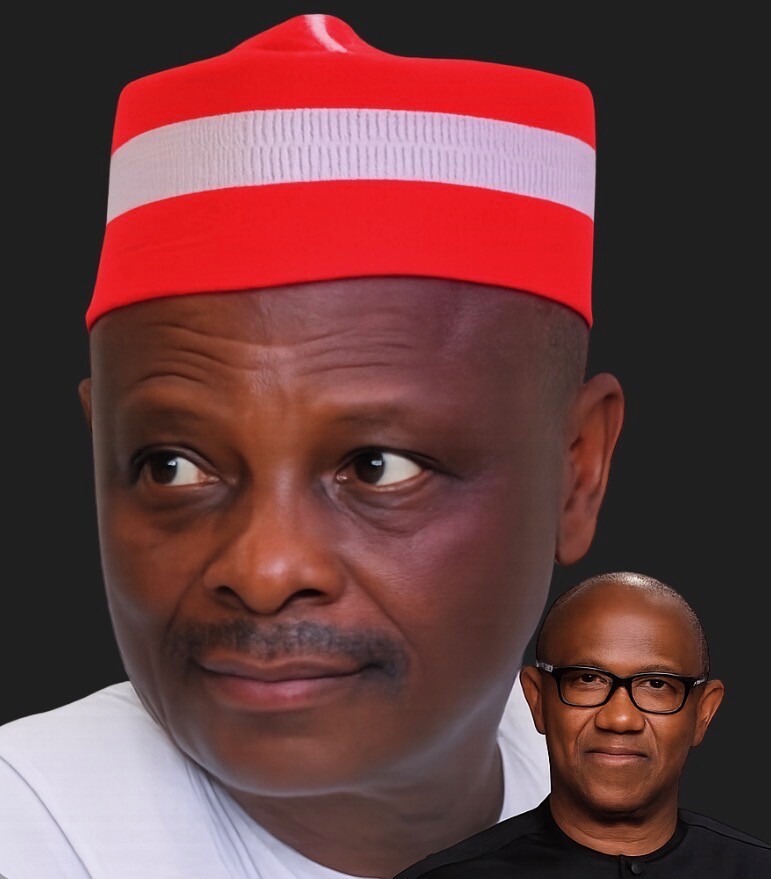
By Professors Chike Maduka, Okereke Uzodinma, Charles Nkeonyeka, and Boniface Orji
Former Governor of Kano State, Rabiu Musa Kwankwaso, has now confirmed what Ndi Igbo in particular, and Nigerians in general, have every right to find deeply disturbing and every reason to reject.
During a recent interview on Channels Television, Kwankwaso said that Peter Obi signed a written agreement committing himself to serve only one four-year term if elected president in 2027. According to Kwankwaso, the agreement provides that presidential power will unconditionally return to the North after Obi’s single term. He also stated that separate agreements were signed by the candidates and their political party.
Make no mistake: this is not merely an agreement between Obi and Kwankwaso. It is a political contract between Obi and the North.
Some Igbo figures have accepted it too easily, reasoning that once Obi assumes office he can simply tear up the agreement. That reasoning is a trap because it overlooks the political consequences of either choice.
If Obi wins in 2027, itself a considerable if, and then honors the one-term pledge, he hands the presidency straight back to the North in 2031, reducing a historic victory to a single borrowed term in which little of lasting substance could be accomplished. A president governing on a countdown, with his successor already identified, spends his one term not building a legacy but marking time until he must surrender the office.
If, on the other hand, he breaks the agreement, the North withdraws the very support that helped put him in office. He loses his bid for a second term and, more significantly, no Igbo candidate after him is likely to be trusted with the same support. His single act of defiance hardens into a lasting political liability for the Igbo. Since no one has won the Nigerian presidency without carrying the bulk of the Northern vote, breaking the agreement would not merely end Obi’s political career. It could also close the Igbo path to the presidency for a generation.
The result is a no-win bargain. Honor the agreement and he governs on probation. Break it and he poisons the well for every presidential candidate who comes after him.
Obi’s ambition to become president does not justify accepting conditions that compromise the independence and effectiveness of the office. No candidate should be so desperate for power that he agrees in advance to become a transitional figure in another politician’s succession plan.
A Placeholder Igbo President
People familiar with the agreement, who spoke on condition of anonymity because they were not authorized to discuss it publicly, said a group of Northern elders made the terms unmistakably clear to Obi and his team. Northern support would come on one condition, and one condition only: that he serve a single term and, more importantly, remain faithful to an agenda and set of policies approved by them.
If that account is accurate, it explains why this arrangement is so damaging to both democracy and the country. A president who owes his office to a backroom bargain does not govern with complete independence on behalf of the people who elected him.
In effect, a 2027 victory, if possible at all, will make Obi a placeholder president, handed the office with an expiration date already stamped on his forehead. He would have no political capital to pursue an independent agenda, no leverage to challenge those who engineered the arrangement, and no credible path to seek a second term. He would be a lame-duck president from his first day rather than his last, holding the title while the North retained the political leverage that would determine both the exercise of executive power and the succession that followed.
Such an arrangement would reduce the presidency from a constitutional mandate to a conditional tenancy, where authority exists on paper but remains constrained by a prior political bargain.
With Kwankwaso breathing down his neck, Obi would not govern as the man in power but as the man keeping the seat warm for Kwankwaso, exactly as the agreement contemplates. Consequently, if elected, Obi would govern to satisfy the Northern power bloc and the man to whom he had committed himself. Every appointment, every policy, and every budget line item would become a bargaining chip to keep that political arrangement intact rather than a decision made solely in the national interest. That is not leadership. It is stewardship exercised on borrowed authority.
He would arrive with no agenda of his own, only the one prescribed by his masters, free to execute their program but never his own. That inverts the real order of things. Kwankwaso becomes the puppet master and Obi the puppet, the ceremonial Igbo face on a presidency whose substance belongs to someone else, while the Igbo who celebrate the win are left as the circus clowns, applauding a show staged at their own expense.
The Nigerian people are therefore being asked to vote for more than a presidential ticket. They are being asked to endorse the first stage of a succession plan that could determine the direction of national power for twelve years: four years under Obi as caretaker, followed by a possible eight years under Kwankwaso.
The Obi-Kwankwaso agreement is not a democratic solution. It is an elite bargain that places political convenience above effective government and regional entitlement above the sovereign right of Nigerians to judge their president at the ballot box.
What if, after four years in office, Obi delivers for the Nigerian people? Should a private political agreement deny Nigerians the opportunity to reward success with a second term? Or should the judgment belong to the electorate rather than to a devil’s bargain negotiated behind closed doors?
Nothing in the Constitution guarantees that Kwankwaso would win the presidency in 2031 or remain in office for two terms. Voters would still have to decide. But the political purpose of the agreement is clear. Obi’s presidency would serve as a temporary bridge before power returned to the North.
That should alarm anyone who believes Nigeria is a constitutional republic rather than a property to be divided among political blocs. The presidency is not a relay baton that two politicians can privately agree to exchange. It is not an ethnic compensation package. It is not a regional timeshare. It belongs to the Nigerian people, who alone should determine who governs, for how long and under what conditions.
Obi’s supporters may describe the one-term promise as a sacrifice. It is nothing of the sort. It is the classic Igbo Discount: the expectation that the Igbo must surrender part of their constitutional rights before they are considered fit to hold the nation’s highest office. It is an act of desperation and self-interest, not sacrifice. That is why, according to an online survey conducted by African Mind after the agreement was announced, many Nigerians, including a majority of Ndi Igbo, oppose it.
An Igbo presidency should not be reduced to a symbolic four-year appearance intended to complete a regional rotation before the office is returned to the North. That is not inclusion. It is tokenism. The question is whether common sense will prevail over Obi’s blind ambition, reason over desperation, and whether Ndi Igbo will at last demand the same constitutional right to the presidency that every other group already enjoys, without the Igbo Discount.
Obi Will Be President in Name Only, a PINO
By signing an agreement not to seek another term, Obi has effectively promised another politician and another region that Nigerians will not be given the opportunity to evaluate his record and decide whether he deserves to continue. The message is simple: give me the presidency now, and I will surrender it after four years.
The consequences of such an arrangement would become apparent almost immediately. Everyone would know that Obi could not seek another mandate without violating a written political agreement. Everyone would know that his vice president, Kwankwaso, had the longer political future. Everyone would know that the centre of political gravity would gradually shift away from the caretaker president toward the expected successor.
No serious country should knowingly create a government with two competing centres of political authority: a president whose departure has already been promised and a vice president presented as the principal beneficiary of that departure.
Against that background, Nigerians should ask why Obi, who claims to possess the competence, discipline, and vision required to rescue the country, would voluntarily impose such a severe limitation on his own administration.
The problems facing the country are many and complex: an economy in distress, insecurity, corruption, a mounting debt burden, decaying infrastructure, and a struggling education system, to name just a few. They require legislation, administrative reform, political discipline, institutional capacity, sustained implementation, and, above all, time.
To address these problems, a first-term president like Obi must appoint ministers, form a government, negotiate with the National Assembly, establish control over the federal bureaucracy, design policies, secure funding, confront entrenched interests, and begin implementation. Even under favorable conditions, the first year can be consumed by appointments, budgets, and institutional adjustments. By the time serious reforms begin producing measurable results, the administration may already be entering another election season.
Four years may be enough to launch reforms. It is often not enough to protect them from reversal, complete major infrastructure projects, rebuild institutions, or establish a new political culture.
This challenge becomes even greater when the president’s party does not control the National Assembly. Opposition lawmakers and political power brokers would know that he had imposed an expiration date on his own authority. They will delay. They will obstruct. They will refuse cooperation and wait for his term to end.
Those who opposed his policies would have little reason to compromise with a president who had already promised to leave. Those seeking to benefit from the next administration would begin positioning themselves immediately. Civil servants, legislators, governors, contractors, and party officials would gradually shift their loyalty to Kwankwaso, where they expected executive power to reside after four years.
Kwankwaso who expects to inherit the presidency after four years would not be an ordinary deputy. He would be a waiting successor with every incentive to build his own political machine inside and outside the government. In this case, ministers would seek Kwankwaso’s favour. Lawmakers would cultivate him. Governors would negotiate with him. Business interests would study his priorities. From day one of Obi’s presidency, party leaders will begin preparing for the coming transition.
As Obi’s single term progressed, the political authority of the vice president could grow while that of the president declined. This is the foundation for a placeholder presidency. Obi might remain president in law, but his ability to exercise independent political power could become increasingly restricted by the succession arrangement that brought him into office.
He would be President in Name Only, a PINO, occupying Aso Rock while the next phase of the agreement shaped the behaviour of the government around him. This is how a president becomes weak before his term has properly begun. This is the fate of an Obi presidency, if it happens.
Knowing all this, is Obi truly acting in the best interests of the nation, or in his own?
Despite repeated attempts to contact Peter Obi before publication, he did not respond to requests for comment.
This agreement is a fatal blow to the Obi-Kwankwaso campaign, and it makes the choice facing Nigerians in the 2027 presidential election harder rather than easier. President Tinubu, the incumbent, holds the lowest approval ratings of any recent president. He is widely disliked for his policy failures and the hardships they have inflicted on ordinary Nigerians. Yet the opposition offers nothing novel to solve the many problems confronting the country.
By entering into their one-term agreement, Obi and Kwankwaso have shown that they cannot be taken seriously as the leaders Nigeria needs. If no new leader emerges before the election, Nigerians will face a stark choice between an incumbent who has already failed them and an opposition that has signaled it is neither prepared nor capable of delivering a better outcome.
We write as patriotic Nigerians and proud Igbo people, and we believe in one principle above all: merit. Who governs Nigeria should be decided by vision, competence, integrity, courage, the capacity to solve problems, and the strength to lead, not by the passive rotation of the presidency from one tribe, region, or religion to the next.
A nation that hands power by turn rather than by merit will always be governed by whose turn it is, never by who is best. We reject that bargain. Nigeria does not need another caretaker of a quota; it needs the finest leader it can produce, and it should be free to choose that leader without conditions, without expiration dates, and without the shackles of a devil’s bargain that lends power for a term only to reclaim it.
To sign the one-term Devil’s Agreement in his own blood, and indirectly in the blood of thirty-five million Ndi Igbo, Obi must ask whether he grasps its long-term consequences.
And it insults the very thing it pretends to honor. Handing the Igbo a hollow crown is not inclusion, it is mockery, a way to buy silence with a title while real power sits elsewhere. A people offered a figurehead in place of genuine president have been given nothing at all. The country does not heal its divisions by manufacturing a puppet and calling it progress. It deepens them, and teaches every region watching that the presidency is not won at the ballot box but auctioned in private.
The Igbo people deserve better. If it is their turn to produce a president, it must not be a devil’s bargain. It must not be a token gesture. It is a shame that under the desperation to become the first Igbo president since after the war, Obi signed this devil’s bargain. When will Nigeria allow an Igbo man to be a whole person?
In conclusion, if Obi is elected, he should govern as the president of Nigeria, not as a temporary occupant of the office serving out a regional arrangement. His tenure should not end simply because an informal power-sharing timetable has run its course. Likewise, President Tinubu should not remain in office if he is ineffective simply because his region claims it is entitled to complete an agreed term. The only legitimate basis for remaining in or leaving office should be the Constitution and the will of the Nigerian people.


